


You're probably looking at a purchasing sheet while production keeps moving. One site wants new boning knives because the current lot won't hold an edge through the shift. Another wants pouches and belts because tools are ending up on benches, rails, and wash stations. Someone in QA is asking whether the handles and carry gear are easy to sanitise. Someone in operations is asking why knife spend keeps rising when “a knife is a knife”.
It isn't.
In a high-volume Australian room, a butcher knife set sits in the same category as aprons, scabbards, sleeve protectors, bandsaws, and vacuum equipment. It affects yield, speed, fatigue, hygiene, and whether your crew can stay organised under pressure. Consumer guides miss that because they treat knives like kitchenware. On a chain, on a trim table, or in a small shop running hard all week, the knife set is production equipment.
Table of Contents
- Beyond the Kitchen A Butcher Knife Set Is a Tool of the Trade
- Anatomy of a Professional Butcher Knife Set
- The Science of Steel Blade and Handle Materials
- Optimising for Ergonomics and Workplace Safety
- Knife Maintenance Sanitation and Compliance
- Effective Storage and Tool Carry Solutions
- Procurement Guide A Wholesale Buyer's Checklist
Beyond the Kitchen A Butcher Knife Set Is a Tool of the Trade
The first hour of a busy kill floor tells you very quickly whether the knife set was chosen by someone who understands production. Blades start slipping in wet gloves, operators swap tools because the profile is wrong for the cut, and the supervisor is already dealing with wasted motion that will keep showing up all shift.
A domestic set can look polished on a bench and still fail in a commercial room. Processing work in Australia means blood, fat, cold-room temperatures, repeated sanitising, hard contact surfaces, and constant movement between stations. A working set has to hold up under that routine without creating extra fatigue or hygiene risk.
You hear it in the cut. Cheap steel chatters against resistance, the edge rolls early, and the hand starts compensating. A proper boning or breaking knife tracks through the seam cleanly, keeps the wrist closer to neutral, and finishes the job with fewer corrective strokes. That saves time, but even more valuable, it reduces strain and helps protect yield.
For abattoirs, boning rooms, trim lines, and retail processing areas, knives sit in the same purchasing conversation as aprons, mesh gloves, scabbards, belts, and steriliser access. They are production tools tied directly to throughput, safety, and sanitation. Procurement decisions need to reflect that reality.
One practical filter helps. If the set is built around presentation, gift packaging, or a broad “all-purpose” pitch, it usually does not belong on a hard-running floor.
Procurement officers new to meat processing often start with unit cost. That approach causes trouble fast in high-volume sites. The first question is job fit: beef breakdown, lamb boning, skinning, trim work, and portioning all place different demands on blade shape, stiffness, handle grip, and carry method. A skinning station, for example, benefits from a dedicated profile such as an Ergogrip skinning knife used by Australian butchers, rather than asking staff to force a general-purpose blade through membrane and hide work.
Good sets remove friction from the station. Bad sets create workarounds. Once operators start borrowing the wrong knife, laying tools on surfaces because the pouch setup is poor, or pushing a tired edge through product to keep pace, the costs show up in slower line speed, more rework, preventable injuries, and harder compliance control.
Anatomy of a Professional Butcher Knife Set
On a busy kill floor or boning room, the wrong knife shows up fast. An operator reaches for a blade that is too wide for seam work, too stiff for close boning, or too short for clean trimming, and the result is slower cuts, more wrist strain, extra rework, and poorer yield control.

A professional set is built around task sequence, not catalogue appearance. In Australian high-volume environments, that usually means separate knives for boning, breaking, skinning, trimming, slicing, and edge maintenance, plus a carry setup that keeps tools controlled between the station, steriliser, and wash-down routines.
What belongs in a working set
| Tool | Best use on the floor | What goes wrong if it's missing |
|---|---|---|
| Boning knife | Working close to bone, joints, and seams | Staff use a wider blade and leave meat behind |
| Breaking knife | Splitting larger sections into manageable primals or sub-primals | Cuts get rough and control drops |
| Skinning knife | Pulling hide and membrane cleanly | Operators overwork the product with the wrong edge |
| Cleaver | Heavy separation through tough cartilage or bone | Other knives get abused |
| Slicing knife | Clean portioning and even finished cuts | Presentation and consistency suffer |
| Honing steel | Daily edge realignment | Sharp knives become “dull” long before they need reshaping |
| Sharpening stone or regrind pathway | Edge restoration | Staff keep forcing tired blades through the product |
That mix shifts by operation. Lamb boning lines often prefer narrower, more agile profiles. Beef plants doing table trim or aerial trim need blade shapes that stay efficient over repetitive, high-volume cuts. Retail and value-added rooms usually carry fewer heavy tools and more portioning knives.
A specialised skinning profile is a good example. This Ergogrip skinning knife used by butchers in Australia shows how different the right blade becomes once the job is defined properly.
Why blade geometry matters on the floor
Blade geometry is tied directly to workflow. In Australian processing rooms, curved narrow de-boning blades around 150mm are commonly used for close work around bone, while wider table-trim blades around 250mm are used to move through bulk trimming more efficiently, according to industry benchmarks for butcher knife sets.
The trade-off is straightforward. A narrow curved blade gives control and helps reduce waste on seam work, but it is slow for broad trimming. A wider trim knife covers more surface area and improves pace, but it is clumsy around joints and fine detail. Good sets account for both jobs instead of asking one knife to do everything.
That difference matters over a full shift. Give a trimmer a generic chef-style knife and the job still gets done, but the edge will not track contours cleanly, hand position becomes less natural, and correction cuts increase. Give the operator the right profile and the cut path settles down.
Set design also affects consistency across crews. A product reference that cites a 2024 University of Queensland study reports that butcher knife sets with 7 to 9 pieces, including boning, skinning, and honing knives, improved throughput in mincing and cutting operations by 34% by standardising blade access and cutting angles, according to this product list reference carrying the study claim.
For procurement, the practical lesson is simple. Buy the set around the sequence of cuts, the sanitation routine, and how the crew carries tools on the floor. That is what keeps production moving and keeps the knife issue from turning into a safety issue.
The Science of Steel Blade and Handle Materials
A knife that suits a retail counter can fail fast on a boning room floor. In an Australian abattoir or processing plant, steel has to hold an edge through repetitive cuts, resist corrosion through constant wash-downs, and tolerate sharpening practices that vary across crews and shifts.
What high-carbon stainless means in practice
Professional butcher sets used in commercial processing often specify X50CrMoV15 for boning and breaking knives because it gives a workable balance of edge life, stain resistance, and toughness in wet environments, as outlined in this professional butcher's knife set specification. The listed composition, roughly 0.5% carbon, 15% chromium, 0.2% molybdenum, and 0.15% vanadium, explains why this grade remains common in meat plants that deal with blood, fat, sanitiser, and frequent rehandling.
On the floor, the question is not whether a steel sounds premium. The question is how it behaves after repeated steeling, line contact, cold-room use, and end-of-shift cleaning.
That is why harder steel is not automatically better.
A very hard blade can keep a keen edge longer, but it usually asks more from the sharpening program and is less forgiving if operators twist through joints or contact hard surfaces. Cheap stainless sharpens quickly, but the edge drops away too fast for high-volume trimming and boning. Mid-range commercial stainless is usually the right buying decision for mixed crews because it gives stable performance without becoming a maintenance problem.
Procurement teams should judge blade steel against four operating realities:
- Corrosion resistance under chlorinated or food-safe chemical wash-down routines
- Edge stability during repetitive commercial cuts, not just first-use sharpness
- Toughness when knives are used hard by different operators
- Sharpening tolerance so the blade recovers well on steels and stones already used on site
Those points matter more in large Australian facilities than they do in consumer guides. Plants need knives that stay serviceable within documented sanitation and sharpening routines, not knives that perform well only under careful home-kitchen treatment.
Handle materials that hold up in wash-down conditions
Handle material affects hygiene, control, and replacement cost. In processing rooms, the safest handle is usually a moulded, non-porous synthetic that stays secure with wet gloves or greasy hands and does not create cleaning traps around the ferrule or blade entry.
A slick handle slows work because operators start compensating with grip pressure. That increases hand fatigue and reduces fine control. A handle with deep grooves, gaps, or poorly finished joins creates a sanitation problem as well as a comfort problem, especially where knife issue and return procedures are tied to QA checks.
Colour also has a practical role. Many Australian processors use colour coding to separate task types, departments, or allergen-control zones. If the set supplier cannot provide consistent handle colours across replacement stock, standardisation starts to break down.
Three checks sort good handles from poor ones quickly:
- Wet grip security. The handle should stay indexed during push and pull cuts without extra squeeze force.
- Clean blade-to-handle transition. The join should be sealed and easy to inspect after sanitation.
- Chemical and impact durability. The material should resist cracking, swelling, and surface breakdown from regular wash-down and daily belt or pouch carry.
A knife set for commercial use is not just blades in a box. Steel choice affects service life and sharpening load. Handle choice affects hygiene checks, user control, and whether the knife still belongs on the line after months of real production.
Optimising for Ergonomics and Workplace Safety
A knife can be sharp, durable, and still be wrong for the job if the balance is off. Procurement teams often see ergonomics as a comfort issue. On the floor, it's a safety and output issue.

Balance fatigue and control
An unbalanced knife asks the operator to do extra correction on every cut. That might look minor in the first half hour. Across a full shift, it shows up as slower tip control, more wrist strain, rougher cuts, and more near misses when the product shifts unexpectedly.
This is easy to see with a cleaver or breaking knife. If the weight is all forward with no stable grip, the user fights the tool rather than directing it. If the handle is too short or too round, the hand can't index the blade position consistently. That's when fatigue becomes a risk factor.
A good ergonomic fit usually has these traits:
- Neutral wrist position for the primary cut the knife is meant to perform
- Secure indexing so the operator can feel blade orientation without looking
- Enough handle texture to stay planted, but not so much that it abrades the hand
- Weight that matches the task instead of pretending one profile suits everything
The knife and PPE have to work together
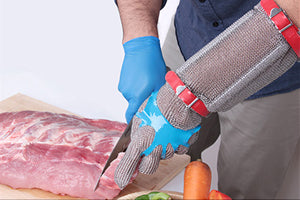
Knife safety never sits with the blade alone. The set has to work with mesh gloves, sleeve protectors, aprons, and the way the site carries tools between stations. If the handle becomes clumsy when worn with cut-resistant hand protection, the issue isn't the glove. It's the combination.
That's why trialling matters. Put the knife in a worker's hand while they're wearing their normal PPE. Have them perform a realistic task. A boning knife that feels fine bare-handed can become awkward once gloves, moisture, and production pace are added.
This short demonstration is useful because grip and handling are easier to judge in motion than on paper.
A knife that only feels good in a showroom won't hold up in a trim room.
Knife Maintenance Sanitation and Compliance
Buying a good butcher knife set is the easy part. Keeping it safe, sharp, and compliant is where most sites either stay disciplined or start bleeding money through bad habits.
The wider market is moving toward better tools. The global professional chef knife set market, which includes butcher knife sets used in commercial meat processing, is projected to grow from USD 1.5 billion in 2024 to USD 2.3 billion by 2033 at a 5.2% CAGR, reflecting increased investment in high-performance cutting tools, according to this professional knife set market projection. More spending doesn't help by itself, though. What matters is whether the site maintains the tools properly after purchase.
Honing is not sharpening
A lot of knife issues start with people using the right words loosely. Honing realigns the edge. Sharpening removes material to create a fresh edge. Regrinding goes further and corrects an edge that has lost shape or has damage.
The simplest way to explain it on site is this:
- Honing steel. Daily upkeep. Keeps a working edge aligned between tasks or during the shift.
- Sharpening stone or system. Restores bite once honing no longer brings the knife back.
- Professional regrind. Resets the blade when wear, shape loss, or edge damage goes beyond routine correction.
If your team needs a plain-language reference for the first part of that routine, this guide to keeping knives razor sharp with a regular cut sharpening steel is worth handing around.
A workable sanitation routine
A maintenance routine only works if operators can follow it during real production. Keep it simple and repeatable.
- Clean immediately after use or station change. Blood and fat left on the blade or handle are harder to remove once they dry.
- Inspect the edge and handle together. A clean blade with residue around the handle join still fails the standard you want.
- Sanitise after cleaning, not before. Sanitiser isn't a substitute for removing visible contamination.
- Dry before storage. Putting a wet knife into a pouch or wrap invites trouble.
- Separate damaged knives fast. Don't let chipped, rolled, or suspect blades drift back into circulation.
The maintenance conversation also has a compliance side. One of the least discussed questions in commercial buying is how often blades should be reground versus replaced. The available guidance is often too vague for high-volume operations. The verified data notes that this gap matters because hygiene failures can be linked to blade condition and micro-splintering, and demand for lifecycle tracking is rising among processors. That tells buyers something important. Generic calendar-based advice isn't enough. Maintenance has to reflect actual usage and inspection results.
Effective Storage and Tool Carry Solutions
Most knife injuries and contamination problems don't happen while the blade is cutting meat. They happen while the knife is being carried, parked, swapped, or stored badly.
Why loose storage causes trouble
A knife left loose on a bench picks up contamination, loses its edge, and creates confusion about ownership and cleaning status. Open belt carry isn't much better in a wet room because the blade stays exposed to fluids and contact.
In AU-region abattoirs, knives stored in scabbard-style pouches show a 65% lower rate of edge damage and contamination transfer compared to open belt carry, according to a 2023 Meat & Livestock Australia safety guideline cited on this butcher knife pouch collection page. That's one of those figures buyers should pay attention to because it links a simple accessory choice to both blade condition and hygiene control.

The same general principle shows up in broader carry systems as well. Dedicated pouches and wraps reduce random handling, keep blades organised, and make it easier for supervisors to see whether tools are where they should be.
What a good carry system looks like
Australian-designed knife wraps made from 14oz poly/cotton ripstop canvas with a PVC front are used in professional sets to protect blades during transport between stations and support rapid visual inspection of cleanliness in wet areas, according to this professional butcher package with heavy-duty canvas wrap. That same reference notes that misplaced knives can cost 10–15 minutes of lost productivity per shift in abattoirs and butcher shops.
For carry on the body, pouch design matters more than people think. A useful setup should:
- Cover the edge fully so the blade isn't exposed during movement
- Drain and clean easily so fluids don't sit in the carrier
- Hold position on the belt instead of swinging around with every step
- Allow quick identification of what's inside without excessive handling
If you want a practical example of how these systems are used, this overview of a butcher knife pouch gives a solid sense of the role pouches play in day-to-day workflow.
Good storage isn't an accessory purchase. It's part of the knife system.
Procurement Guide A Wholesale Buyer's Checklist
A purchasing mistake shows up fast on a processing floor. The wrong set slows trim speed, creates sharpening complaints by mid-shift, and leaves supervisors chasing replacement stock sooner than planned. Good procurement ties the knives, the users, the sanitation program, and the carry system into one buying decision.
For Australian abattoirs, boning rooms, and high-throughput butcher shops, that usually means buying for site conditions first. Wet work areas, washdown routines, HACCP-based sanitation controls, glove use, and shift-by-shift issue of tools all affect what should go in the set and how many sets you need in reserve.
Questions worth asking before you place the order

Use a checklist that reflects actual plant use:
- Match the set to the cut list and line speed. Retail portioning, lamb processing, beef breakdown, and heavy trim all call for different blade shapes and replacement rates.
- Check who is using the knives. A skilled boner may want narrower, more specialised profiles. Mixed-experience crews usually perform better with standard patterns that are easier to control and easier to replace.
- Review steel and handle suitability for your sanitation regime. The set has to hold up under frequent washing, chemical exposure, and constant wet handling.
- Order pouches, belts, or wraps with the knives. If tool carry is left off the purchase order, knives end up carried loosely, stored poorly, or issued inconsistently between stations.
- Confirm the sharpening and regrind process before approval. Site sharpening capacity, contractor turnaround, and spare knife numbers all affect how well the set will perform over a month of production.
- Assess whole-of-life cost. Edge retention, breakage rates, cleaning time, replacement frequency, and supplier consistency have more impact on spend than the carton price alone.
- Ask about continuity of supply. If a handle colour, blade pattern, or pouch model changes without warning, training, stockholding, and issue control get harder.
One decision matters more than many buyers expect. Standardising a site-wide knife set makes training, stock control, and replacement ordering much cleaner, especially across multiple shifts. A custom kit by station can improve fit for specialised tasks, but it also adds complexity to purchasing, spare stock, and supervisor sign-off.
If you're buying for a butcher shop, abattoir, processor, or hospitality operation and want one wholesale source for knives, PPE, aprons, pouches, machinery, and related meat-processing supplies, PSC TRADING Co PTY LTD is set up for that kind of commercial environment.
