



You're on the cutting floor, the line is moving, the bench is wet, and your knife hand is doing the same motion for the hundredth time that morning. That's when shortcuts show up. A glove that's too loose. A strap that doesn't sit right. A worker who leaves the mesh glove hanging because they “just need to trim this one piece”.
That's how people get hurt, and in a meat room, it's also how a site falls out of compliance. Chain metal gloves aren't just another PPE line item. They affect worker safety, hygiene, purchasing, training, wash-down routines, and how confidently a supervisor can sign off on knife work in a high-risk area.
For a new butcher, the glove can feel awkward at first. For a manager, the bigger mistake is treating all cut protection as interchangeable. It isn't. The right glove for deboning isn't always the right glove for packing, bandsaw support work, or wet clean-down areas. Selection matters. Fit matters. Maintenance matters even more than many realise.
Table of Contents
- Your First Line of Defence on the Cutting Floor
- How Chain Metal Gloves Actually Work
- Decoding Safety Standards and Certifications
- How to Choose the Right Chain Metal Glove
- Chain Metal vs Fabric and Coated Gloves
- Hygiene Cleaning and Maintenance Protocols
- Making Gloves Part of Your Workplace Safety Plan
Your First Line of Defence on the Cutting Floor
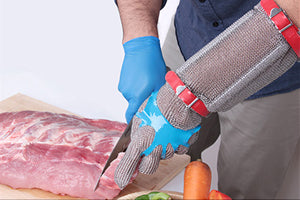
On a busy kill floor or in a retail boning room, the non-knife hand is always closest to trouble. It's holding, turning, steadying, or pulling product while the blade tracks past it again and again. That's why chain mesh gloves, made from interlocking stainless steel mesh rings, are mandated PPE for workers using hand knives in the Australian meat processing sector under Australian occupational health requirements, as noted by ATS Global's chain mesh glove guidance.
A new butcher usually notices the glove only after the first few awkward cuts. It feels heavier than a fabric glove. It changes how you grip. It can catch your attention at the wrist if the fit is wrong. None of that means you can skip it. It means the glove has to match the job and the worker.
What the glove is doing for you
On the floor, chain metal gloves serve two roles at once:
- They protect the support hand: The glove takes the risk where the knife is most likely to slip across flesh, trim fat, or ride off bone.
- They support compliance: If your task involves hand-knife work in an Australian meat environment, the glove isn't a personal preference item.
- They shape workflow: The right glove lets a butcher keep control during trimming, slicing, and deboning instead of fighting poor fit all shift.
Practical rule: If the task puts a hand close to a moving knife edge, treat the glove as part of the process, not an accessory.
In real sites, the glove choice affects more than safety. Procurement teams need to order the right sizes. Supervisors need clear rules on who wears what. Wash-down crews need a cleaning method that protects both food safety and glove life. A useful background read on that overlap between protection and sanitation is this article on why stainless steel mesh gloves matter for safety and hygiene.
How Chain Metal Gloves Actually Work
A chain metal glove works a lot like old chainmail armour. The difference is that this version is built for knife rooms, not battlefields. Thousands of small steel rings link together to form a flexible surface that wraps the hand while resisting the edge and point of a blade.
A flexible barrier, not a magic shield
The glove doesn't make the hand invincible. It changes what happens when a knife slips. Instead of a blade edge cutting straight into skin, the interlocked rings interrupt the cut path and spread the force across the mesh. That's why these gloves are effective against the kind of slicing and stabbing contact that happens in trimming, deboning, and portioning work.
Think about a common deboning motion. Your support hand pulls tension on the cut while the knife hand follows the seam. If the blade jumps off the line, the glove is there to meet the edge first. A cotton glove won't do that. A light coated glove usually won't do it either.
A chain metal glove is a flexible shield of steel. It moves with your hand, but it doesn't give a knife a clean path through to skin.
That said, the glove only works when it's worn properly. If the wrist strap is loose, the glove can shift during repetitive work. If the fingers are too long, dexterity drops and workers start adjusting the glove instead of concentrating on knife control. If the glove is used near rotating equipment, fit matters even more because loose gloves and sleeves create a different hazard.
Why stainless steel matters on the floor
The metal matters as much as the mesh pattern. In food environments, chain metal gloves are commonly made from 304L or 316 stainless steel. Those grades are used because they hold up in wet, messy, wash-down conditions far better than ordinary steel would.
The glove also needs to survive contact with meat juices, regular cleaning chemicals, and repeated sanitising without becoming a contamination problem itself. A rusting glove isn't just a maintenance issue. It becomes a food safety issue and a trust issue for the team using it.
Two practical differences show up quickly in use:
- 304L stainless steel: Suitable for many processing environments where corrosion exposure is controlled.
- 316 stainless steel: Better suited where moisture, saline fluids, and aggressive cleaning routines are part of normal production.
If you've ever seen a worker stop mid-task to shake out a poorly fitted glove or wipe product from a fastener that traps residue, you already know this isn't just about cut resistance. Good chain metal gloves need to protect, clean up properly, and stay comfortable enough that people will keep them on.
Decoding Safety Standards and Certifications
A lot of glove buying goes wrong because buyers look at “cut resistant” on a label and stop there. On a meat processing site, that's not enough. You need to know which standard applies, what the rating means, and whether the glove is certified for the type of knife work being done.
What Level F means in practice
In Australian abattoir and high-risk blade environments, chain metal gloves must achieve EN 388:2016 Level F cut resistance, which requires more than 30 Newtons of force to cut and is identified as the rating certified for protection against hand knives in deboning and trimming operations, according to Prof-Tek's butcher glove specification.
That matters on the floor because “cut resistant” covers a wide range of products. A glove built for carton handling or general warehouse work might still be a poor choice for knife contact in a boning room. Level F is the top cut category in the EN 388 framework mentioned in the verified data, and that's the level you should expect to see for serious blade exposure in meat work.

For a new butcher, here's the plain-English version. If your knife slips during trimming a primal or opening up along a seam, the glove needs to be built and certified for that direct contact. General-purpose cut gloves don't automatically meet that bar.
The standards that matter when you buy
Three standards come up again and again in Australian buying decisions:
- EN 388: Covers mechanical risks. In this context, the key point is the cut rating.
- EN 1082-1: Covers protection against cuts and stabs from hand knives.
- AS/NZS 2161: Covers occupational protective gloves in Australia and New Zealand.
A procurement officer should be checking the spec sheet, not just the catalogue title. If the listing doesn't clearly state the standard, ask for the compliance documentation before it reaches the floor. That habit saves arguments later with auditors and supervisors.
Buying rule: If the supplier can't clearly show the glove standard, don't assume the glove belongs in a knife task.
Sites that stock multiple glove types benefit from a simple matrix in the storeroom: task, required glove type, required rating, approved model. That reduces the chance of a new worker grabbing the wrong item during a busy start-up. For a broader look at matching hand protection to task risk, PSC Trading's guide to choosing the right safety gloves is a useful companion read.
How to Choose the Right Chain Metal Glove
Choose the glove the same way you would set up a knife task. Start with the job, the worker, and the wash-down routine. Price matters, but it sits behind injury risk, audit requirements, and whether the glove will stay on the hand through a full shift.
On a busy boning line, the wrong glove creates problems fast. The worker loses feel at the fingertips, starts overgripping the product, loosens the strap, then takes shortcuts to keep up. That is not just a comfort issue. It affects knife control, hand position, and compliance on the floor.
Start with the task, not the catalogue
Selection should match the way the hand is exposed during the task. A retail butcher trimming steaks at the block uses the support hand differently from a worker opening seams on beef primals or trimming lamb shoulders at speed. If the glove blocks grip or wrist movement, the worker will fight it all day.
Use the task to narrow the glove:
- Deboning and trimming: Prioritise stable fit, finger control, and a fastening that stays secure through repetitive movement.
- Portion cutting on a bench: Comfort matters because the hand position stays repetitive for long periods.
- Wet poultry or seafood work: Corrosion resistance and easy cleaning deserve more weight in the buying decision.
- Mixed-task rooms: Ambidextrous gloves can simplify stock control when workers rotate between stations or switch hands.
Do not rely on a catalogue photo or product title. Ask how the glove will be issued, how often it will be washed, who will inspect it, and whether the room runs shared PPE or individual issue. In Australian food processing, those decisions affect both safety performance and audit performance.
Fit, cuff length and fastening
Poor fit causes two predictable failures. Dexterity drops, and the worker starts adjusting the glove instead of focusing on the cut. That is when straps get left loose, the wrong size stays in service, or the glove comes off for a quick trimming job that turns into a laceration.
A good fit looks like this:
- Snug, not tight: The glove should follow hand movement without pinching the fingers or pulling across the knuckles.
- No excess finger length: Long fingertips reduce feel and make small, controlled cuts harder.
- Secure wrist closure: The strap should hold through repeated flexing, wash-down handling, and station changes.
- Cuff matched to exposure: Wrist-length gloves suit some bench tasks. Longer cuffs help where the blade path or product position brings the lower forearm closer to the hazard.
Extended cuff options are common in meat plants because wrist protection is not always enough. If a worker is reaching into a primal, trimming close on a wet bench, or working in a posture where the knife tracks upward, extra cuff coverage can reduce exposed area. It adds bulk, so it needs to be tested on the actual task.
If a worker says the glove feels unsafe, check size, strap tension, and cuff interference before blaming technique.
Chain Metal Glove Feature Selection Guide
| Feature | Common Options | Best For... | Consideration |
|---|---|---|---|
| Hand design | Ambidextrous, left-hand, right-hand | Mixed workforces or task-specific allocation | Ambidextrous stock is simpler to manage, but some workers prefer hand-specific feel |
| Cuff length | Wrist length, extended cuff | Bench trimming, deboning, higher forearm exposure tasks | Longer cuffs add coverage but can feel bulkier |
| Steel grade | 304L, 316 stainless steel | General meat processing, wetter or more corrosive areas | 316 handles tougher wet conditions better |
| Fastening | Plastic wrist strap, buckle-style closure | Repetitive knife work and wash-down environments | The closure must stay secure and clean easily |
| Weight and feel | Lighter mesh feel, heavier-duty feel | Precision work versus harsher handling | More protection can mean less fine dexterity |
| Stock strategy | Individual issue, shared pool, station-based stock | Small shops, large plants, multi-shift rooms | Shared gloves demand tighter hygiene and inspection routines |
The best buying decision is usually made on the floor with a trial, not at a desk with a spreadsheet. Put the glove into the specific task. Check whether the worker can hold product cleanly, keep a natural wrist position, wash the glove properly at break, and return it without damage. If the glove works in production conditions, it has a much better chance of staying compliant in service.
Chain Metal vs Fabric and Coated Gloves
People get into trouble when they assume every cut-resistant glove belongs in every cutting job. It doesn't. Chain metal gloves and fabric or coated gloves solve different problems.
Where chain metal wins
In Australian meat processing, hand protection for high-risk blade contact has to deal with knife edges and bandsaw-related hazards. Chain metal gloves are mandated under AS/NZS 2161.10 for high-risk tasks where blade contact occurs, with a minimum cut-resistance of Level 5, according to the CSIRO-published reference.
That tells you where chain metal belongs. Use it when the hand may take direct knife contact during tasks such as:
- Deboning a forequarter: The support hand is close to the blade while tension is applied through the cut.
- Opening seams on lamb or beef primals: The knife can skate off connective tissue.
- Close trimming on a wet bench: Product slip increases the chance of the blade shifting off line.

Chain metal also has a hygiene advantage in many food rooms because the surface can be cleaned and sanitised more directly than absorbent materials. That doesn't make maintenance optional, but it does make the glove more suitable for regular wash-down routines.
Where fabric and coated gloves make more sense
Fabric and coated gloves still have a place on the floor. They're often better when the hazard is abrasion, general sharp-edge handling, light incidental cut risk, or when dexterity is the main requirement and direct knife exposure is low.
A few practical use cases make the split clearer:
- Packaging area work: Handling cartons, trays, or sharp plastic edges often suits fabric or coated gloves better.
- General handling away from direct blade contact: Lighter gloves reduce fatigue and improve feel.
- Cold-room tasks or secondary processing: Workers may need grip and comfort more than knife-stab resistance.
The mistake is using a fabric glove where a chain metal glove is required. A butcher trimming around bone with a pointed blade needs protection built for that contact. A packer loading vacuum bags probably doesn't need chain mesh on the hand.
Match the glove to the hazard, not to the department name. Two workers standing three metres apart can need completely different hand protection.
Hygiene Cleaning and Maintenance Protocols
A clean chain metal glove protects the worker and protects the product. A dirty one creates two problems at once. It raises the risk of a hand injury if the mesh or fasteners are damaged, and it raises the risk of a food safety breach if protein, fat, or sanitiser residue is left on the glove and sent back into production.
That is why glove care is not just a housekeeping task. In an Australian processing room, it is part of compliance, audit readiness, and line discipline. The glove sits right in the middle of PPE control and food-contact hygiene. If your site runs under HACCP, chain mesh gloves need to be written into the same cleaning, inspection, and release-to-use controls applied to knives, aprons, and other repeat-use equipment. This HACCP overview for food businesses is a useful reference if you are tightening those controls.

On the floor, the failure point is usually not the steel. It is the routine.
A worker finishes a lamb breakdown shift, drops the glove into a tub with aprons, and grabs it again next morning without a proper check. By smoko, dried fat is still sitting in the joins near the cuff, the strap has started to crack, and nobody has formally signed off that the glove was clean and fit for use. That is how avoidable hygiene issues turn into audit findings, and how damaged PPE stays in service longer than it should.
A daily clean-down routine that works
The best routine is the one the team can repeat every shift without shortcuts. In most butcher shops and meat rooms, that means a set wash point, approved chemistry, and one person clearly responsible for checking the glove before it is stored or reissued.
A practical routine usually includes:
- Pre-rinse immediately after use: Remove visible meat, fat, and connective tissue before it dries into the mesh.
- Brush all contact points: Scrub the rings, cuff area, strap fittings, and closures where residue collects.
- Wash with site-approved cleaner and sanitiser: Use the same chemical controls and contact times required for other food-contact tools.
- Rinse thoroughly: Cleaning chemicals left on the glove are a problem as well.
- Dry completely before storage: Hang or rack the glove so air reaches the mesh and fittings.
- Store off the floor in a clean area: Keep it out of damp bins, mixed PPE piles, and loose knife gear.
Hot water and strong chemicals help cleaning, but they can also shorten the life of straps and plastic fasteners if the product is wrong for the glove. That trade-off matters. Hygiene is the priority, but the cleaning method still has to match the glove design.
What to inspect before the next shift
Inspection should happen before the glove goes back onto a hand, not halfway through a trimming run. A leading hand, QA check, or trained operator should be able to reject a glove in seconds.
Check for:
- Broken, split, or missing rings: Any opening in the mesh can let a knife point through.
- Pulled or distorted sections: Misshapen mesh changes how force spreads across the glove.
- Loose, cracked, or worn straps and buckles: A glove that shifts during boning is not doing its job.
- Corrosion, burrs, or rough edges: These can affect hygiene and create new snag points.
- Residual product after cleaning: If debris is still trapped in the glove, it is not ready for production.
Some mesh gloves can go back through an approved repair process. Others should be tagged out and replaced straight away. The decision should be clear and documented, especially on sites with formal PPE registers or audit requirements.
Use a simple standard. If the glove is not clean, intact, and secure on the hand, it does not go onto the line.
Making Gloves Part of Your Workplace Safety Plan
Sites that manage gloves well don't treat them as a once-off purchase. They build them into daily operations. That means stocking enough sizes, assigning the correct glove to each knife task, training new starters on fit and use, and giving clean-down the same attention as knife sharpening and apron washing.
The strongest glove program usually has a few basics in place:
- Clear issue rules: Workers know which glove belongs to which task.
- Routine inspection: Supervisors and workers both check condition before use.
- Defined replacement triggers: No one debates whether a damaged glove can “last one more shift”.
- Good storage and washing points: Gloves are easy to clean, dry, and reissue properly.
A glove on its own won't fix poor knife technique, weak supervision, or sloppy wash-down habits. But the right chain metal glove, correctly selected and managed, removes one of the most serious hand injury risks in a butcher shop or processing plant.
If you're reviewing hand protection across your site, it helps to work with a supplier that understands knife-room PPE, food-processing hygiene, and Australian meat operations. PSC TRADING Co PTY LTD supplies equipment, PPE, aprons, and processing essentials for butcher shops, abattoirs, and food businesses that need practical gear for active production environments.
