

If you're buying aprons for a butcher shop, abattoir, or meat processing facility in Australia, you've probably noticed something in the last five years: the old standard PVC apron is getting quietly replaced by TPU. Here's what's actually driving the switch, what to look for when you buy, and the mistakes that cost Australian businesses thousands in wasted PPE every year.
The short version
PVC aprons were the industry standard for decades because they were cheap, waterproof, and good enough. They're still fine for a lot of jobs. But for high-wear environments — commercial butchery, seafood processing, abattoirs, anywhere you're pressure-washing and sterilising daily — TPU has quietly become the better buy.
Not because TPU is trendy. Because the cost-per-shift works out lower when you actually do the maths.
What is a TPU apron, and why should you care?
TPU stands for thermoplastic polyurethane. It's a flexible, waterproof, food-grade material that's used in medical equipment, marine gear, high-end outdoor clothing, and — for about the last decade — industrial workwear.
In apron form, TPU gives you three things PVC never quite managed:
- Welded construction instead of stitched — no thread holes for liquid to seep through
- Lighter weight — about 30% lighter than an equivalent PVC apron, which matters more than you'd think around hour six
- Better chemical and temperature resistance — doesn't stiffen in cold rooms or go tacky in hot wash-downs
The trade-off used to be price. TPU cost significantly more than PVC. That gap has closed. In 2025, a quality TPU apron is only 10–20% more than a PVC equivalent — and it lasts two to three times longer in the same conditions.
The real cost of a cheap apron
Here's the maths nobody does when they're buying PPE on price alone.
A $12 PVC apron in a commercial butchery typically lasts 3–6 months before the stitching fails, the grommets pop, or the straps go stiff from repeated washing. Call it four months average. That's three aprons a year per worker. In a 20-person processing team, that's 60 aprons a year at $12 — $720. Plus the time spent reordering, restocking, and handing out replacements.
A $19 TPU apron in the same environment lasts 12–18 months. Call it 14 months average. That's roughly 0.85 aprons per worker per year. Twenty workers = 17 aprons = $323. Plus a lot less admin.
Over a year, that's a 55% reduction in apron spend. Before you factor in labour time, stockroom space, or the cost of a worker stopping the line because their apron just tore through.
This is the reason procurement managers at larger Australian meat processors stopped buying the cheapest option about five years ago. The cheap option was costing them more.
What to look for when buying a TPU apron in Australia
Not every TPU apron is built the same. Here's what actually matters — and what doesn't.
1. Welded seams, not stitched
This is the single most important spec. If the apron has visible stitching along the seams, it's not a true TPU apron — it's a TPU-coated fabric apron with the same failure point as PVC. Every thread hole is a pathway for fat, blood, and water to work into the material.
A properly made TPU apron is welded at every seam, including where the straps attach. You shouldn't see a single stitch.
2. Welded eyelets, not grommets
Grommets are metal rings pressed into a hole in the apron. They're the second-biggest failure point after stitching — they work loose under pressure washing, they corrode, they fall out, and once one goes, the strap rips through.
Welded eyelets are formed as part of the apron itself. No separate part to fail. No metal to corrode. They last as long as the apron does.
3. TPU ties and buckles, not cloth
Cloth straps are the hidden weakness in most "heavy-duty" aprons. They soak up moisture, go stiff overnight, fray at the buckle, and add weight you don't want. TPU ties and buckles are cleanable, quick-drying, and last the life of the apron.
If your apron has cloth ties, you'll be replacing them before the apron body fails — and most manufacturers don't sell replacement straps.
4. Correct size for the job
The standard Australian commercial size is 900mm × 1200mm. That's full bib coverage from chest to mid-shin on most workers. Anything smaller is a compromise. Anything bigger is for specific heavy-duty applications (abattoir kill floor, for example, where you want coverage down past the boot top).
If you're seeing 700mm × 900mm listed as "heavy-duty" — it's not. That's a light-duty size being marketed up.
5. Food-grade certification
If the apron is going to be worn in any food-contact environment, the material needs to be food-grade certified. For export-registered Australian meat establishments, this is not optional — it's a compliance requirement. Check that the supplier can provide documentation on request.
6. Made where, exactly?
"Made in Australia" and "Designed in Australia, manufactured overseas" are two very different things. If the apron is actually made in Australia, you get:
- Shorter lead times (days, not weeks)
- Warranty support from people who built the product
- Ability to request custom sizes, colours, or branding without MOQ issues
- Australian labour standards in the supply chain
Our TPU aprons are cut, welded, and finished in our workshop in Capel Sound, Victoria. If you need a replacement or a custom order, you're talking to the people who made it — not a distributor three countries removed.
Common mistakes Australian buyers make
Buying on price alone
We've covered this above, but it's worth repeating: the cheapest apron is almost never the lowest-cost apron. Do the per-shift maths before you commit to a bulk order.
Ignoring the reorder cycle
If your team is going through aprons on a schedule you can predict (say, every 4 months), set up a standing order with your supplier. Most reputable Australian PPE suppliers (including us) will hold inventory for you and ship on a schedule so you never run out. This eliminates the "crap, we're out of aprons on a Friday afternoon" problem.
Buying the wrong apron for the workstation
Not every workstation needs a heavy-duty 900×1200 TPU apron. Front-of-house café staff don't need waterproof PPE — a poly cotton bib is fine and much cheaper. Boning room staff do need the full TPU. Matching the apron to the workstation is how you optimise spend without compromising protection.
Skipping the strap upgrade
Even on a premium apron, the straps take the most wear. Consider ordering replacement strap packs alongside your apron order — they're cheap, easy to swap, and they can double the functional life of an otherwise-perfect apron.
Who should stay with PVC?
To be fair to PVC — it's still the right call in some situations.
- Low-wear environments — light food prep, occasional use, catering setups where the apron isn't getting daily pressure-washing
- Short-term or disposable use — event catering, one-off jobs, apprenticeship training where aprons get lost or damaged regularly
- Very high chemical exposure — certain industrial chemicals eat TPU faster than PVC, so check your specific environment
- Tight-budget operations — if upfront cash is the limiting factor and reorder frequency isn't the main concern
For everyone else — and this is most of the Australian commercial meat, seafood, and food processing industry — TPU is now the default recommendation.
How PSC Trading's TPU apron is built
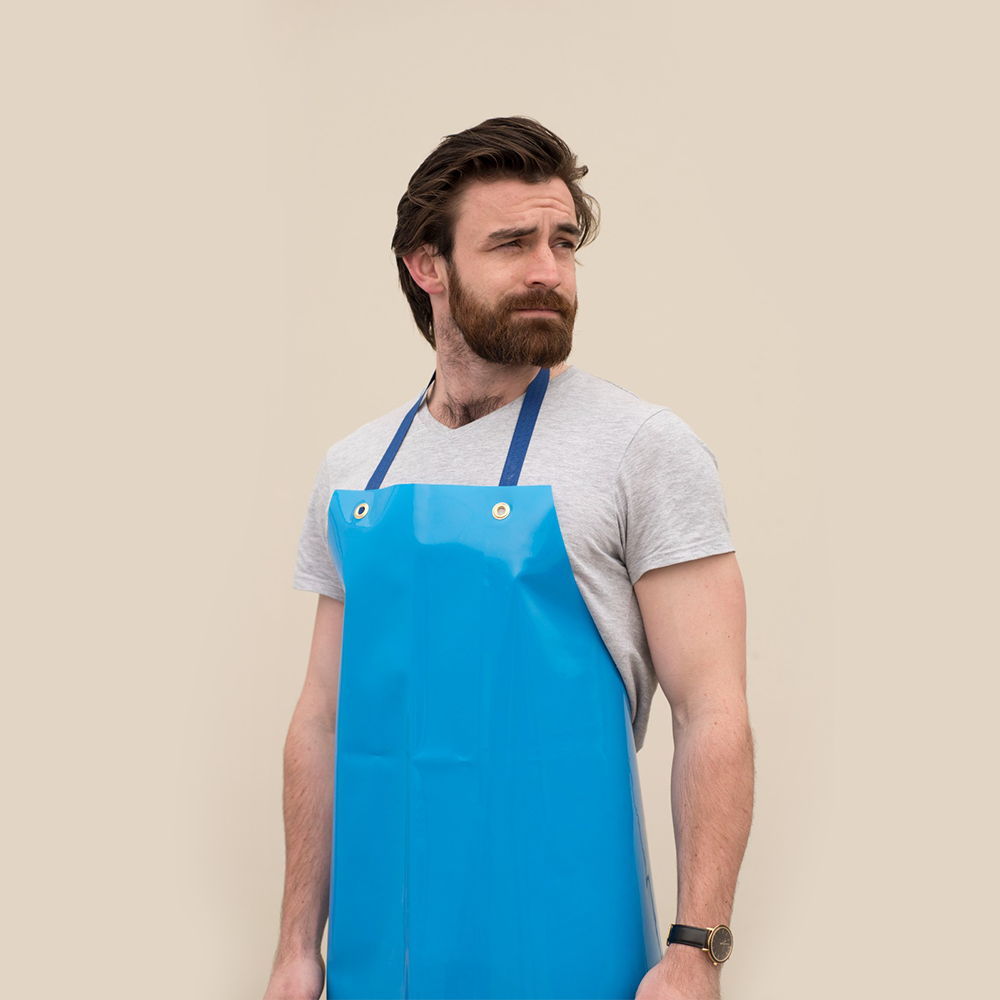
We make our heavy-duty TPU Food Processing Apron to a single high spec:
- 900mm × 1200mm full bib coverage (the Australian commercial standard)
- Welded seams throughout — no stitching anywhere on the apron body
- Welded eyelets — no grommets to pop
- TPU ties and buckles — no cloth, no fraying, no soaking up moisture
- Food-grade — rated for direct food contact environments
- Made in Capel Sound, Victoria — not imported, not re-badged
- Available from $19 with volume pricing at 6+, 12+, and 24+ units
It's designed for the real conditions of Australian commercial food processing — long shifts, daily pressure wash-downs, cold room to hot wash cycles, and the kind of wear that destroys cheap aprons in months.
Shop the TPU Food Processing Apron →
Bulk orders and trade accounts
If you're buying aprons for a team of more than five, it's worth setting up a trade account. You get:
- Tiered pricing at 6+, 12+, and 24+ units
- Scheduled delivery so you never run out mid-shift
- Custom branding available (your shop or company logo)
- Direct contact with the people who make the product
- Same-day dispatch from Victoria for urgent orders
Email info@psctrading.com.au or call +61 409 909 551 to talk to us about a wholesale quote. We supply butcher shops, abattoirs, meat processors, seafood operations, and commercial kitchens across Melbourne, Sydney, Brisbane, Adelaide, Perth, and every regional postcode in between.
FAQ — Quick answers
How long does a TPU apron actually last?
In daily commercial use with proper care, 12–18 months. Some of our customers report 2 years+ with careful handling. Compared to 3–6 months for a typical PVC apron in the same conditions.
Can you wash a TPU apron?
Yes. Hose it down, wipe it down, or pressure wash it. It's rated for commercial sterilisation cycles. Don't tumble dry — hang it to dry (which takes about 10 minutes anyway).
Is TPU food-safe?
Yes. Our TPU aprons are food-grade and rated for direct food contact environments, including export-registered Australian meat establishments.
Can I get TPU aprons with custom branding?
Yes — we do custom branding for orders of 20+ units. Logo, shop name, or custom colours. Lead time is typically 2–3 weeks.
Do you ship Australia-wide?
Yes. Every state, every territory, every postcode. Same-day dispatch from Victoria on orders placed before 2pm AEST. Melbourne metro is next business day; most other capital cities are 2–3 business days.
What's the minimum order?
No minimum. Order one apron or order a thousand. Volume pricing kicks in at 6+ units.
The bottom line
If you're running a commercial butcher shop, meat processing facility, or abattoir in Australia and you're still buying the cheapest PVC apron you can find, there's a decent chance you're spending more per year than you need to.
A quality TPU apron costs slightly more upfront. It lasts 2–3 times longer. It saves your team time. It looks better. And it works out cheaper in cents-per-shift.
That's not a marketing claim. That's what happens when you do the maths.
Shop the Heavy-Duty TPU Food Processing Apron from $19 →
PSC Trading has been manufacturing and supplying aprons, butcher equipment, and food processing PPE to Australian businesses since 2013. Based in Capel Sound, Victoria, we ship Australia-wide and supply butcher shops, abattoirs, meat processors, and hospitality operations across every state. Contact us on +61 409 909 551 or info@psctrading.com.au.
