



You're usually looking at cling wrap when something has already gone wrong. The tray line is moving, someone tears the film at the wrong angle, the cutter snags, the wrap won't hold on a cold meat tray, and now two staff are fighting a basic consumable while product waits on the bench. In a butcher shop or prep kitchen, that isn't a small annoyance. It slows packing, wastes film, and creates avoidable mess at the worst time of day.
That's why 600m cling wrap matters more than people give it credit for. In trade use, it isn't just a longer roll. It's a workflow tool. The good rolls keep tension properly, cut cleanly, cling without needing to be yanked half across the room, and hold up when you're wrapping awkward trays, bone-in cuts, sausage trays, or bulk pans for coolroom storage.
The frustration in the trade right now is that not every 600m roll performs like an old-school commercial roll used to. Plenty still say 600m on the box. That doesn't tell you enough. Film thickness, resin type, stretch, cutter quality, and dispenser fit make the difference between a roll that earns its keep and one that burns labour all week.
Table of Contents
- Why Your Business Runs on the Right Roll
- Decoding the Specs What 600m Cling Wrap Really Means
- The Bottom Line Calculating Cost-Efficiency per Metre
- Food Safety and Material Science
- Best Practices for Wrapping and Storage
- Beyond the Label The Hidden Truth About Cling Wrap Quality
- FAQ for Butchers and Hospitality Operators
Why Your Business Runs on the Right Roll
A home-style roll fails fast in a commercial setting. You see it on a busy Saturday morning. One person is packing lamb chops, another is covering trays for the display, and the roll is already half crushed, the film is bunching near the edge, and every third pull tears crooked. Staff start overpulling because they don't trust the cling. That creates more waste than the box price ever shows.
A proper 600m cling wrap roll changes that rhythm. In the Australian commercial food sector, 600m rolls standardised at 33cm provide 198 square metres per roll, and that format supports roughly 1,800 individual 33cm seals or 900 double-width seals according to product specifications from BASP and Milestone Chemicals Australia. In practical terms, that's why trade users moved away from short consumer rolls years ago. One commercial roll gives the bench far more continuity during service.
A busy bench doesn't tolerate weak consumables
Take a butcher packing mixed orders. Thin consumer film might be fine on a flat sandwich container. It struggles on a tray of marinated chicken wings, a foam tray with sharp corners, or a roast with an uneven profile. The operator pulls harder, the film necks down, and the seal line weakens. Then the tray goes into the coolroom looking wrapped, but not properly sealed.
By contrast, commercial-length film is built around repeated use. Historical industry data notes that the 600m roll became the standard commercial unit in the early 2000s, replacing 450m variants in high-volume meat processing. That happened because throughput matters more than shelf convenience in trade environments.
Practical rule: If your team changes rolls during the rush, you're not buying cling wrap. You're buying interruptions.
Why the right roll becomes a production tool
The best operators treat wrap the same way they treat knives, vac bags, or aprons. It has to be reliable. It has to fit the job. And it has to behave the same way every time.
A solid commercial roll helps with:
- Bench speed: Fewer roll changes means less stop-start packing.
- Seal consistency: Trays leave the bench looking the same across the shift.
- Cold-chain confidence: Wrapped product holds better in storage and transport.
- Staff safety: Better dispensers and cutters reduce rough handling.
That's the value. You're not only buying film. You're buying smoother prep, fewer restarts, and less frustration at the packing station.
Decoding the Specs What 600m Cling Wrap Really Means
The label says 600m. That only tells you how long the film is. It doesn't tell you whether it will hold on a wet tray, tear around a bone point, fit your dispenser, or cut cleanly at pace. Buyers who stop at the length usually end up disappointed.

Length isn't the whole story
Length matters because it affects uptime. In Australian commercial food environments, 600m cling wrap is typically made from high-grade PVC at 9 to 20 microns and can deliver elongation up to 300%, while the 600m length reduces changeover frequency by up to 65% compared with standard 150m rolls, as listed in Castaway's 45cm x 600m product specifications. On a bench, that means fewer moments where someone has to stop, lift the dispenser, reload, and get back into rhythm.
That said, long length doesn't rescue poor film. A bad 600m roll gives you a longer period of annoyance.
Width affects speed more than most buyers realise
Width changes the way the roll behaves in actual work.
A 33cm roll suits smaller packs, single meat trays, deli items, and day-to-day wrapping where control matters more than broad coverage. It's easier to handle on a compact bench and wastes less film when you're sealing narrow trays.
A 45cm roll is a better fit for larger platters, bulk catering pans, broad foam trays, and oversized cuts. The wider sheet reduces the need for overlap on big items and gives better coverage on awkward shapes. In practice, that means fewer double-wrap attempts.
A simple rule works well:
| Job on the bench | Width that usually suits |
|---|---|
| Sausage trays, steaks, chops, deli containers | 33cm |
| Large roast trays, platters, bulk prep pans | 45cm |
Microns, material, and dispenser fit
At this stage, buyers separate good trade stock from marketing fluff.
Micron gauge is the film thickness. If a supplier won't tell you the thickness, you're buying blind. Thickness affects puncture resistance, handling feel, and how much force staff need to apply before the film deforms too much. Consider the difference between a flimsy liner and a proper heavy-duty bag. Both are technically bags. Only one behaves properly under stress.
Material type changes cling, stretch, and heat behaviour. Some commercial products are sold in PVC. Others may use LDPE or PVDC depending on the product line and application. Those chemistry differences show up in daily use. One film may have better cling on trays. Another may suit different heating or storage conditions better.
Core diameter matters for one simple reason. If the roll doesn't fit your dispenser properly, everything gets worse. The roll drags, wobbles, tracks badly, and cuts unevenly.
A buyer should check these basics before ordering:
- Ask for micron range: If the answer is vague, treat that as a warning.
- Confirm resin type: PVC, LDPE, PVDC, or another formulation affects performance.
- Check width against your tray sizes: Don't let the shelf decide for you.
- Match the core to the dispenser: A good roll in a bad fit feels like a bad roll.
- Inspect the cutter style: Integrated cutters save time only when they're aligned and sturdy.
If a supplier can only repeat “excellent cling” and “premium quality” but can't tell you the gauge or material, they're asking you to trust packaging copy instead of product performance.
The Bottom Line Calculating Cost-Efficiency per Metre
Procurement teams often look at the box price first. That's understandable, but it's the wrong starting point for a consumable used all day. A cheap-feeling roll that fights the operator can cost more in waste and labour than a properly made roll with a slightly higher upfront price.

What the roll price actually tells you
For a 33cm x 600m commercial roll, the Australian market price sits between $22 and $27 AUD, which works out to about 4 cents per metre. That's the figure buyers should benchmark against, because metre cost is what lets you compare rolls fairly.
Here's the simple calculation:
| Roll price | Roll length | Approximate cost per metre |
|---|---|---|
| $22 AUD | 600m | about 4 cents |
| $27 AUD | 600m | about 4 cents |
That metre cost matters more than whether one carton looked cheaper on the invoice. In a packing room, film is consumed by length and failed wraps, not by the number of cardboard boxes you purchased.
The hidden cost sits on the packing bench
A roll that tears early or won't cling properly creates costs that never show up neatly in purchasing reports.
Common examples:
- A second wrap pass: Staff use extra film because the first seal doesn't hold.
- Crooked cuts: The first sheet is wasted before it reaches the tray.
- Frequent roll swaps: Packing stops while someone reloads the dispenser.
- Poor hold on wet trays: Product needs rewrapping before display or storage.
Those are labour costs in disguise. They also create presentation problems. In meat retail, a messy tray looks mishandled even when the product itself is fine.
Buy on cost per usable metre, not cost per box. If half the film gets wasted through bad handling characteristics, the cheap roll was never cheap.
The smartest buyers don't ask only, “What does this roll cost?” They ask, “How much of this roll ends up on saleable product?”
Food Safety and Material Science
Food wrap isn't only about cling. It sits close to product, often touches fat and moisture, and gets used in coldrooms, prep areas, and sometimes reheating situations. If the material isn't suited to the job, you end up with either poor protection or poor handling, and sometimes both.
In Australian butcher and abattoir environments, food-grade cling wrap is typically manufactured from LDPE or PVDC, materials used to maintain a tight seal against air and moisture so meat products keep their condition better during storage and handling. In the broader market, some commercial films are also sold in PVC, which many operators know for its stretch and cling characteristics.

What the material choice means in practice
Material names sound technical. On the bench, they translate into handling behaviour.
PVC-type films are usually chosen when users want strong cling and easy stretching over awkward tray shapes. That makes them popular for display wraps and uneven loads.
PE-family materials, including LDPE, are often considered where heat tolerance or broader packaging compatibility matters. They may feel different in the hand and don't always cling in the same way as PVC-style films.
PVDC-based films are valued for barrier performance. In meat handling, that matters when you're trying to reduce air exposure and maintain product condition through storage and movement.
A practical buyer should be asking:
- What food is this wrapping most often? Fatty cuts, deli items, or prepared trays can behave differently.
- Will it be heated later? “Microwave-safe” on the pack still requires correct use.
- Does the film taint sensitive foods? Cheese and oily meats show up flavour transfer quickly.
- Is the formulation food-safe and BPA-free? Those labels matter, but they don't replace proper handling.
For operations tightening their systems, PSC Trading's HACCP-focused food safety article is worth reading alongside your packaging review.
Microwave use, taint, and food-contact habits
Australian guidance for commercial cling wrap includes products labelled microwave-safe and BPA-free, with advice to keep at least one inch of space between the wrap and high-fat or sugary foods during heating. That gap matters because direct contact under heat can increase the risk of melting or unwanted migration.
The practical habits are simple:
- Don't let wrap sit directly on fatty hot food: Raise it off the surface where possible.
- Use only film labelled for that purpose: Not every cling film should go near reheating.
- Keep cold-chain discipline: A good wrap helps, but it doesn't replace temperature control.
- Watch for taint issues: Delicate products show flavour transfer fast if the film quality is poor.
Good cling wrap supports food safety. It doesn't rescue sloppy handling, overfilled trays, or poor storage discipline.
Best Practices for Wrapping and Storage
Technique matters more than people think. Even a decent roll performs badly if staff grab it at the wrong angle, over-stretch it, or try to force one width onto every job in the room.

Commercial 600m rolls sold in Australia are equipped with integrated stainless steel blade cutters, which is exactly what busy meat processors and hospitality kitchens need for smoother cutting and better workflow. A proper cutter is not a luxury. It stops the sawing motion that ruins edges and slows packing.
How to wrap common butcher items properly
Different products need different handling.
Sausage trays and flat packs
Use enough film to anchor one long edge first. Then draw the sheet across with steady tension rather than maximum tension. Sausage trays usually fail at the corners when staff pull too aggressively and thin the film before it lands.
Bone-in cuts and sharp profiles
Don't drag the film straight over the pointiest section first. Land the film on the flatter side, then smooth toward the sharp edge. If a cut has a hard bone corner, use your palm to guide the film around it rather than snapping it tight across the point.
Large roasts and catering trays
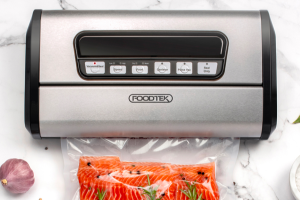
With larger items, centre the tray before you pull. Most wasted film on broad trays comes from starting off-centre and needing a second sheet. If your operation wraps a lot of bulk product before vacuum packing, it also helps to review where cling wrap should stop and vacuum bags should take over. This guide to vacuum machines and freshness is useful for that crossover point.
A short visual walkthrough helps when training new staff:
Storage and handling that keeps film usable
Wrap quality doesn't only depend on manufacturing. Storage can ruin a good roll.
Keep these habits on site:
- Store rolls clean and dry: Damp, greasy cartons lead to handling issues before the film even hits the bench.
- Protect the box edges: Crushed ends often mean the roll won't track properly in the dispenser.
- Keep the cutter clear: Fat, dust, and scraps on the blade line make every cut rougher.
- Train for controlled tension: Staff should stretch enough to seal, not enough to thin the film out.
- Match the roll to the station: Don't move one dispenser all over the room unless you have to.
A roll that cuts cleanly and tracks straight stays useful longer. A bent box and dirty cutter can make premium film behave like bargain stock.
Beyond the Label The Hidden Truth About Cling Wrap Quality
A lot of people in the trade have said the same thing over the past couple of years. The wrap doesn't feel the same. It still says 600m. It still looks the part in the carton. But on the bench it tears sooner, clings less confidently, and feels thinner under the hand.
That frustration isn't imagined. One of the biggest gaps in the Australian market is the lack of a standard stretch-to-thickness metric that lets buyers compare film properly. Without that, two rolls can both claim 600m while performing very differently.
Why some new rolls feel worse
The hardest part for buyers is that the downgrade isn't always obvious on paper. The box still says commercial. The length is still there. But if the film gauge is reduced or the resin formulation changes, users feel it immediately.
That matters because the market gap has been linked to a 22% rise in food-waste complaints in Australian abattoirs in 2025 due to premature seal failure. Procurement teams can't easily distinguish between genuine high-volume rolls and thinner alternatives when thickness data isn't disclosed.
There's also wider frustration around formulation changes and reduced seal integrity. Buyers know something has shifted, but public product information often stays vague.
The label can tell you how long the roll is. It may tell you almost nothing about how the film behaves.
Questions worth asking before you buy
If you want to buy better, ask sharper questions:
- What is the micron gauge? Not “premium”, not “heavy duty”. Ask for the actual thickness.
- What resin type is used? Material choice affects cling, stretch, and handling.
- Has the formulation changed recently? Some suppliers won't volunteer that.
- What cutter is fitted? Bad cutting creates waste even when the film itself is decent.
- Is this roll consistent across batches? One good carton doesn't prove ongoing quality.
If your site is balancing performance with waste reduction goals, it also helps to compare wrap choices against broader packaging decisions. PSC Trading's article on sustainable packaging advantages is a useful starting point.
The smart buyer doesn't stop at “600m”. They ask what kind of 600m roll it is.
FAQ for Butchers and Hospitality Operators
Can used cling wrap be recycled easily in a butcher shop?
Usually, good intentions confront reality. Once cling wrap is contaminated with meat juice, fat, labels, or food residue, recycling becomes harder. In practice, many sites treat used wrap as contaminated soft plastic waste unless they have a very specific recovery stream. Clean handling and using only the amount needed helps more than assuming everything can be recycled later.
When should I use something other than cling wrap?
Use cling wrap when you need quick tray coverage, short-term storage, visibility, and fast bench work. Switch to butcher paper when presentation or breathability matters more. Switch to vacuum bags when you need a tighter long-term seal, stronger protection during storage, or better control over air exposure. Each format has its place. Problems start when one product is forced to do every job.
Why does the film keep tearing on bones or sharp tray corners?
That usually comes down to one of three issues:
- The film is too thin for the task: Ask for the micron gauge.
- The wrapping angle is wrong: Start on the flatter surface and work toward the point.
- The operator is over-stretching: More pull doesn't always mean a better seal.
If the same roll tears repeatedly across different staff and different stations, don't blame technique alone. The film quality may be the issue.
If your team needs commercial-grade cling wrap, meat processing supplies, PPE, aprons, vacuum packaging gear, or broader butcher and abattoir consumables, PSC TRADING Co PTY LTD supplies Australian businesses across food processing, hospitality, and industrial packaging.
