

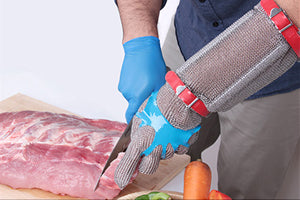
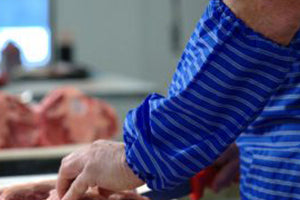

You're standing in a busy butcher shop or kitchen, the first orders are already coming in, and someone's asking for gloves again because the box on the bench is half empty. That's usually when the critical decision shows up. Nitrile disposable gloves aren't just a PPE purchase, they're a daily operating choice that affects hygiene, dexterity, stock control, waste, and how often your team has to stop and change gear.
For Australian buyers, the trick is not finding a glove that looks fine on a shelf. It's choosing a glove that suits the task, holds up in real use, supports food safety, and doesn't push up cost through waste and poor fit. In meat rooms, hospitality kitchens, and food plants, that means looking beyond the box count and thinking about thickness, grip, food-contact compliance, sizing, and end-of-life.
Table of Contents
- What Nitrile Disposable Gloves Are and Where They Fit in Australian Workplaces
- How Nitrile Is Made and Why the Material Matters
- Reading the Spec Sheet Without Getting Lost
- Nitrile vs Latex vs Vinyl for Australian Workplaces
- Food Safety Compliance and On-the-Floor Use
- Getting the Sizing and Fit Right for Real Teams
- Disposal, Sustainability, and the Total Cost of a Box of Gloves
- A Practical Buying and Stocking Playbook for Procurement Teams
What Nitrile Disposable Gloves Are and Where They Fit in Australian Workplaces
Saturday morning in a suburban butcher shop tells you everything you need to know about glove choice. The saw's on, the slicer's being wiped down, the first customer wants a tray of snags, and the team needs gloves that go on quickly, hold grip in moisture, and don't tear the moment someone handles packaging or raw product. That's where nitrile disposable gloves have become the default in many Australian food and meat workplaces.
Why nitrile took over so many benches
Nitrile is a synthetic rubber made to avoid the natural rubber latex proteins that can create allergy problems. It's also valued for puncture resistance and chemical resistance, which is why it's so common in butcher shops, abattoirs, hospitality kitchens, and food-manufacturing lines. The practical difference shows up on the floor, because a glove that survives a rush without constant swapping saves time, reduces frustration, and keeps the work moving.
The other reason nitrile won space on the shelf is simple: it works across a wide range of jobs. A meat handler uses it for portioning and packaging. A kitchen hand uses it for wash-down and prep. A production worker uses it where hygiene and repeat handling matter more than a delicate touch. That flexibility makes nitrile a procurement staple rather than a niche item.
Practical rule: if the glove needs to handle food, resist light splash exposure, and avoid latex-protein risk, nitrile is usually the first material to check.
Where it fits, and where it doesn't
Nitrile isn't magic. It's a disposable glove, so it still needs changing when it's contaminated, damaged, or past the job it was selected for. It also isn't the right answer for every task just because it's popular. The best results come from matching the glove to the job, then training staff to use it properly.
That's why this guide focuses on four things Australian buyers need to get right, spec selection, food-safety fit, team sizing, and procurement strategy. If you're comparing products now, a useful starting point is PSC Trading's own guide on choosing safety gloves for Australian workplaces, which sits in the same practical space as the buying decisions covered here, Choosing the Right Safety Gloves.
How Nitrile Is Made and Why the Material Matters

Nitrile gloves start as a petroleum-derived synthetic polymer, usually nitrile-butadiene rubber, or NBR. That matters because the material isn't just “plastic versus rubber”, it's a compound that can be tuned for stretch, strength, and barrier performance. In plain terms, the chemistry decides how the glove feels on the hand and how long it lasts when a worker is pulling, stretching, or handling greasy product.
From feedstock to finished glove
The manufacturing path is straightforward once you strip away the jargon. Raw petrochemical inputs are turned into the polymer base, the compound is mixed for the intended performance, and then ceramic hand forms are dipped so the glove can be built layer by layer. After curing and finishing, the glove is stripped from the mould, packaged, and boxed for use.
That process explains why two nitrile gloves can feel very different in practice. One may be designed for speed and dexterity. Another may be made heavier for barrier performance. The recipe, the curing method, and the finishing treatment all influence the result.
The specs that matter in the real world
Two words come up again and again on supplier sheets, tensile strength and elongation. Tensile strength is how much force the glove can take before failing. Elongation is how far it can stretch before it gives way. A useful mental image is a balloon or rubber band, one that stretches easily but still snaps back with control is usually better for work than one that feels stiff or flimsy.
That's also where chlorination or other surface finishing matters. Powder-free gloves are popular because they don't cling as badly to sweaty hands and don't leave residue behind. For a kitchen or processing floor, that translates into faster donning and fewer complaints from staff who are changing gloves all day.
Rule of thumb: the more the glove is engineered for chemical and puncture resistance, the more you need to watch what happens to touch sensitivity.
A good procurement conversation starts with the material, not the box colour. If you know how nitrile is built, the next step is reading the spec sheet like a buyer, not a brochure reader.
Reading the Spec Sheet Without Getting Lost
Most glove boxes look similar until you read the fine print. That's where procurement either gets sharper or gets expensive. A supplier can call something “food safe”, “industrial”, or “premium”, but the buying decision still comes down to what the glove is made of, how thick it is, whether it's powder-free, and whether it suits food-contact work.
The four specs that actually change performance
Thickness in mil is the first number people notice. The technical benchmark used in industrial disposable nitrile gloves is 5 mil minimum thickness with ≥14 MPa tensile strength and ≥500% elongation in product spec sheets sold through Australia-linked supply channels, while heavier-duty exam-style variants are commonly 7 mil and marketed for improved chemical and puncture resistance (Tuff Grade specification sheet). In practice, thicker gloves usually bring more barrier margin, but they can cost you some dexterity.
Powder-free status matters in food settings because powder has no place in a contamination-conscious workflow. Texture matters because wet fingers need grip, especially around knives, trays, packaging, and taps. Food-contact compliance matters because a glove can be a decent PPE product and still be the wrong choice for direct contact with ready-to-eat food.
| Spec | What it means | When it matters |
|---|---|---|
| Thickness in mil | How much material is on the hand | Deboning, wash-down, chemical-adjacent tasks |
| Powder-free | No loose powder residue | Food prep, packaging, hygiene-sensitive work |
| Texture | Surface grip on fingertips or palm | Wet hands, oily surfaces, fast changeovers |
| Food-contact declaration | Evidence the glove is suitable for food use | Butchers, kitchens, packing lines, ready-to-eat handling |
What buyers get wrong
The biggest mistake is treating thickness as a universal safety score. It isn't. A thick glove that slows down knife work can create a different risk, because workers start pulling it off early or switching to a poor fit. Colour is another trap. Blue, black, and other colours are useful for visibility or site preference, but they don't prove quality on their own.
For Australian food and meat sites, a better filter is simple. If the glove will touch food, ask for the declaration that supports that use. If the job involves sharp edges, wet surfaces, or brief chemical splash exposure, pay closer attention to thickness and grip. If the task is fine-motor work, don't overbuy heaviness just because it sounds tougher.
Nitrile vs Latex vs Vinyl for Australian Workplaces
The question I hear most often is whether nitrile is worth the spend. The honest answer is that it depends on the task, but nitrile usually wins on the mix of durability, allergy risk, and chemical resistance. That does not make it the cheapest option, and it does not make it perfect. It does make it the safer all-rounder for a lot of Australian food and industrial benches.
How the materials differ on the floor
Latex is still valued for fit and feel, but it brings allergen risk with it. Vinyl is usually the budget choice, but it gives up a lot on puncture resistance and handling toughness. Nitrile sits in the middle on cost and ahead on protection in more demanding jobs.
Independent guidance notes that nitrile performs better than vinyl in use, with nitrile failure rates of 1% to 3% in one study after manipulation, compared with vinyl failures as high as 12% to 61% (AIC guidance on glove barrier performance). That is not a reason to overspec every task, but it is a clear reminder that cheap gloves can become expensive when they fail early.
Nitrile also has limits. It is a fossil-based polymer and not biodegradable, which is part of the sustainability tension buyers need to face (Ansell sustainability note). So the decision is never just performance versus price; it is performance, waste, and how many gloves a team burns through in a shift.
For front-of-house hospitality, latex can still feel nice, but nitrile avoids latex-protein concerns. For meat processing, nitrile is usually the safer all-rounder. For general cleaning with only light contact, vinyl can be adequate if the task is short and low-risk.
The working rule for Australian buyers
If the task is food handling, wet work, or repeated glove changes, nitrile usually earns its place. If the task is low-risk and price is the main driver, vinyl may be enough. If the job needs exceptional tactile sensitivity and the site can manage latex-related risk, latex still has a place.

Food Safety Compliance and On-the-Floor Use
Australian food law doesn't treat gloves as a magic shield. FSANZ Standard 3.2.2 requires food handlers to take all practicable measures to prevent contamination, and to wash hands before handling ready-to-eat food unless they use a suitable barrier such as gloves in a way that doesn't create a contamination risk (Food Standards Australia New Zealand guidance referenced in the brief). That puts the burden on the workflow, not just the purchase order.
What good glove use looks like
A butcher handling sliced ready-to-eat meat can use nitrile gloves, but the glove has to fit the job and the hygiene sequence. If that same worker touches cash, raw product, packaging tape, or a bin lid, the glove is contaminated and should be changed before returning to ready-to-eat work. The glove doesn't replace hand hygiene, it sits on top of it as part of the control system.
The most common mistake is letting gloves drift into a general-purpose status. Staff wear them too long because they feel “clean enough”, then keep moving between raw and cooked or between dirty and clean tasks. That's where the risk lives, not in the box itself.
A practical change-over workflow
- Start clean. Wash and dry hands before donning gloves.
- Use the glove for one task group. Raw, ready-to-eat, cleaning, or packaging should not blur together.
- Change after contamination. Cash, raw product, broken packaging, and wash-down chemicals all trigger a change.
- Remove before touching shared surfaces. Door handles, phones, and registers need a reset.
- Wash hands again after glove removal. Gloves support hygiene, they don't replace it.
That's the operational logic behind a good kitchen or meat room system. It's not about wearing more gloves, it's about wearing them at the right time.
For sites looking to align glove use with broader HACCP thinking, PSC Trading's food-safety note on HACCP in Australia is a relevant internal resource, PSC Trading HACCP and food safety excellence.

Getting the Sizing and Fit Right for Real Teams
A glove can meet every spec on paper and still fail on the floor if it fits badly. I've seen hospitality teams burn through boxes because the wrong size was ordered for the whole venue, which leads to torn gloves, sweaty hands, and staff half-rolling cuffs just to get through service. That's not a glove problem, it's a sizing problem.
Fit affects comfort, speed, and waste
Snug gloves help dexterity and reduce the chance of excess material catching on tools or packaging edges. Roomier gloves can be easier to change quickly in a hot kitchen, but too much slack makes precision work clumsy. The right answer depends on the task, the hand shape, and how often the team changes pairs in a shift.
The best 15-minute fit check is simple. Measure hand length and palm circumference, then have staff try the candidate size while opening packets, picking up a knife, and pinching a small object. If the glove bunches in the palm or pulls hard across the knuckles, it's the wrong size, even if the box says “medium”.
Colour is a workflow choice, not a performance score
Blue and black nitrile are common in food and hospitality settings because they make glove use visible and can suit site branding. That matters for compliance checking and presentation. It doesn't make one glove stronger than another.
If staff keep taking gloves off to adjust them, the size is wrong or the task needs a different gauge.
A useful stocking approach is to keep the most common size in easy reach, then hold smaller and larger sizes for the edge cases. That reduces waste and stops the entire site being forced into a single compromise fit. If you can get the right size on the first attempt, you save more than comfort, you save gloves.
Disposal, Sustainability, and the Total Cost of a Box of Gloves
The cheapest box on the invoice isn't always the most cost-effective glove to use. That matters with disposable nitrile, because a large share of the environmental load sits upstream, before a glove ever reaches a hand. In the University of British Columbia life-cycle assessment, 66.2% of the total greenhouse-gas emissions from one box of disposable nitrile gloves occurred in the production phase (UBC life-cycle assessment). For high-volume users, that shifts procurement away from unit price alone and toward a broader view of waste, usage, and supply risk.
What happens at end of life
Disposable nitrile gloves are generally treated as waste after use, especially once they're soiled or contaminated. Some non-soiled gloves can be collected into recycling or downcycling streams and turned into other plastic products or construction materials, but contaminated gloves still need disposal routes that manage emissions and hygiene risk. That is the main constraint for abattoirs, kitchens, and food plants, not a claim on a carton.
The broader glove market matters too. Global demand was already above 400 billion gloves a year in 2021, which gives a sense of the scale of the waste stream buyers are part of. For Australian operations with steady glove turnover, that scale shows up in bin volume, waste contracts, and ESG reporting pressure.
What to ask suppliers before you buy
- Weight per box: heavier gloves may mean more material and different cost dynamics.
- Gloves per case: case structure affects storage and ordering rhythm.
- Recycled-content claims: ask for the actual basis of the claim, not just the marketing line.
- End-of-life options: check whether the supplier supports any non-soiled collection or recovery pathway.
- Contamination guidance: make sure the waste route matches your site conditions.
PSC Trading also publishes practical material on sustainable packaging for a greener tomorrow, which is useful context for sites trying to line up PPE buying with broader waste reduction work.

A Practical Buying and Stocking Playbook for Procurement Teams
A glove programme works when procurement treats it like a recurring operational system, not a one-off purchase. That means knowing what each task consumes, what the team wears, and where the site loses gloves through bad fit, poor storage, or the wrong specification. It also means putting suppliers under proper scrutiny instead of assuming every box on the market is fit for a food business.
Build the buy around use, not guesswork
Start with tasks. Raw meat handling, ready-to-eat prep, cleaning, packing, and front-of-house all have different demands. Then map the headcount and shift pattern, because a five-person morning team and a weekend rush crew don't burn through gloves the same way.
Once you know the demand pattern, set case sizes and reorder points around reality. That prevents stockouts without filling the storeroom with dead stock. A good glove line should also have more than one supplier on file, because continuity matters when one distributor slips or a size runs short.
Ask suppliers the questions that matter
- Can you provide food-contact documentation? This matters more than a slogan on the carton.
- What batch traceability do you keep? If there's an issue, you need a paper trail.
- What sizes and thicknesses are in stock? Availability beats promise.
- How do you handle recall or non-conformance issues? The answer tells you how mature the supplier is.
- What are the minimum order quantities? That affects your buying cycle and storage pressure.
If you're comparing broadline options, PSC TRADING Co PTY LTD is one supplier that sits in the butcher, abattoir, and hospitality space with PPE and food-processing consumables, so it can be considered alongside other wholesalers when you're building a shortlist.
Keep opened boxes usable
Storage sounds minor until humidity ruins the box and half the gloves become awkward to don. Keep cartons in a clean, dry area away from chemicals and direct sunlight, rotate older stock forward, and don't leave open boxes on wet benches. A glove that's stored badly can fail long before it's ever put under stress.
A solid internal checklist looks like this, task fit, food-contact proof, correct size, stocked by demand, stored dry, and reviewed after use. If your team can answer those six points before they place the next order, you're buying gloves like an operator, not a shopper.
If you're tightening glove spend, improving food-safety controls, or trying to standardise stock across a butcher shop, kitchen, or processing floor, send your current glove specs, sizes, and supplier notes to your procurement lead and compare them against the checklist above before the next order goes out.
