







You're probably looking at a floor plan that seemed workable on paper and already spotting the problems. The cool room door opens into a traffic lane. The wash area sits too close to prep. Staff in aprons, gloves and sleeve protectors have to twist past each other with product in hand. By the time the first busy shift hits, the layout starts fighting the team.
That's what commercial kitchen design comes down to in practice. Not glossy renders. Not whether the equipment list looks impressive. It's whether the room supports safe movement, clean workflow, easy wash-down, and repeatable output when the floor is wet and the pace goes up.
In butcher shops, meat rooms, and abattoir processing areas, worker-centred design matters even more. Staff handle heavy product, stand for long periods, wear bulky PPE, and move between mincers, bandsaws, benches, sealers, sinks and drains. If the layout ignores that reality, fatigue goes up, contamination risk goes up, and productivity drops.
Table of Contents
- The Blueprint for Success Core Layout and Flow
- Mastering Kitchen Zoning for Safety and Speed
- Equipping Your Kitchen for Throughput and Ergonomics
- Essential Services Ventilation and Utilities
- Hygienic Finishes and Effective Cleaning Regimes
- Navigating Compliance Safety and Budgeting
- Conclusion From Plan to Profit
The Blueprint for Success Core Layout and Flow
The first mistake in commercial kitchen design is squeezing the work area after everything else has been decided. That always creates compromise. You end up with prep benches jammed into corners, storage too far from receiving, or staff carrying product through the wrong part of the room.
Start with the space split
In Australia, the broad benchmark is clear. Industry guidelines recommend allocating exactly 60% of total commercial space to front of house and 40% to back of house, including kitchen, storage and preparation areas, according to Lightspeed's Australian commercial kitchen layout guide. For operations where food production is the engine of the business, that back-of-house allocation protects workflow, ventilation, safe separation and staff movement.
There's another practical benchmark worth using early. A commercial kitchen often needs 30 to 40 percent of the total building footprint for cooking, prep, storage and cleaning, as discussed in this commercial kitchen planning reference. For a restaurant, that helps keep service moving. For a butcher shop or abattoir processing room, it gives you the clearance to move carcass sections, tubs, trolleys, packaging and wash-down gear without turning every shift into a bottleneck.
Practical rule: If the room only works when no one is carrying stock, wearing PPE, or cleaning at the same time, it doesn't work.
A simple example shows the difference. A high-turnover restaurant can devote more thought to the pass, hot line and dish return. A butcher shop has a different pressure point. It needs direct movement from receiving into cold storage, then into a raw processing area, then into packing or dispatch, with waste and wash kept out of that stream.
If your operation relies on cold chain discipline, airflow matters too. Good storage planning starts before the first shelf goes in. Products such as freezer pallet spacers for cold storage airflow fit into the layout discussion because poor spacing in the cool room slows handling and complicates stock rotation.
Choose a layout that suits the job
No single floor plan suits every site. The layout has to reflect the menu, the volume, the contamination risk and the physical nature of the work.
| Layout type | Best fit | What works | What fails |
|---|---|---|---|
| Assembly line | High-volume, limited-path production | Strong linear movement from prep to finish | Falls apart if staff need to cross back for tools or storage |
| Galley | Tight footprint operations | Efficient use of narrow rooms | Feels cramped fast when PPE, tubs and product all share the lane |
| Island | Larger kitchens with central production | Good sightlines and supervision | Wastes steps if storage and wash are pushed too far out |
| Zone-based room | Mixed-output sites, butcheries, processing rooms | Supports separation of raw, clean, pack and wash tasks | Fails when zones blur and equipment overlaps |
For many meat-focused operations, a zone-based layout with short, direct transfer points works better than a generic restaurant-style plan. A bandsaw shouldn't sit where finished product passes. A vacuum machine shouldn't force staff to pivot across a main walkway with loaded trays. A wash station shouldn't be the shortcut everyone uses.
Build the flow from receiving to clean-down
The cleanest layouts follow the product journey. Receiving comes first. Then storage. Then prep. Then cooking or processing. Then service or packing. Then dishwashing and cleaning on a separate return path.
This is the workflow worth building into the room from day one.

What doesn't work is a layout that looks symmetrical but forces backtracking. Staff shouldn't collect ingredients from one end, prep in another, then cross behind a hot or dirty zone to reach the next task. In wet production environments, every extra turn and every unnecessary carry increases risk.
Good commercial kitchen design keeps the route obvious. Product moves forward. Waste moves away. Clean tools return without crossing raw handling. Staff don't need to think about the path because the room already decided it for them.
Mastering Kitchen Zoning for Safety and Speed
A workable footprint is only the start. The room still needs discipline. That's where zoning does the heavy lifting. In practical terms, zoning decides who works where, what belongs in that space, and which paths should never cross.
The five zones that matter
Australian kitchen planning guidance identifies five primary operational zones: Storage, Preparation, Cooking, Plating and serving, and Cleaning and dishwashing, as outlined in this guide to kitchen zoning for Australian venues. Those five zones aren't theory. They're how you stop friction on the floor.
Start with storage. Dry, chilled and frozen storage need to be easy to reach without cutting through active prep. Preparation comes next, with enough bench access, tool access and cold access to keep product moving. Cooking or processing sits after prep. Plating, packing or service needs to be close enough to the output point that product doesn't linger. Cleaning and dishwashing must stay out of the production lane.
Here's the practical test. If a worker carrying raw product and a worker carrying dirty equipment have to pass shoulder to shoulder, the zoning is wrong.
The zone relationships matter more than the labels on the plan. Storage has to feed prep. Prep has to feed production. Dirty returns have to leave the line without re-entering it.
A quick visual helps teams spot that logic before fit-out decisions are locked in.

A meat processing example that works
Take a butcher shop breaking down incoming meat for portioning, mincing, sausage production and vacuum packing. The receiving point should feed directly into refrigerated storage. From there, product moves into a dedicated raw prep zone where the bandsaw, benches and mincer are grouped around the actual task sequence.
Finished product then moves to packing and sealing. Dirty trays, knives and tubs head away to wash. Waste goes to its own non-food area. Staff shouldn't need to wheel a bloody tub past packed product to get to the sink.
In meat rooms, speed comes from short reaches and short transfers. Safety comes from keeping raw flow, clean flow and wash flow separate.
This placement logic aligns with common commercial kitchen guidance that puts refrigerated and dry storage immediately beside receiving, while physically separating waste and warewashing from food prep and cooking areas, as described in this commercial kitchen layout reference.
Later in the planning stage, it can help to walk staff through the workflow visually and physically. This short layout video is useful for discussing one-way movement and station relationships with managers and supervisors.
Where zoning usually breaks down
The failures are usually predictable:
- Storage is too remote: Staff keep leaving product on temporary benches because the cool room is inconvenient.
- Cleaning invades production: The easiest sink becomes the default wash point for everything.
- Packing sits in a traffic lane: Finished goods wait where people still need to pass.
- Shared benches blur task boundaries: Raw prep, trimming and final packing all happen in the same footprint.
- Access points are blocked: Fire exits, emergency tools and service paths become storage overflow.
That last point gets ignored too often. A room can be productive on paper and still fail in operation because exits, detectors or emergency access are compromised by mobile equipment, tubs or stock.
Good zoning reduces decisions. The staff member on the floor shouldn't have to invent a safe route mid-shift. The route should already be built into the room.
Equipping Your Kitchen for Throughput and Ergonomics
Equipment selection gets treated like procurement. It should be treated like workflow engineering. The machine matters, but the placement matters just as much. In high-contamination environments, bad equipment placement shows up first in workers' bodies. Twisting, lifting, reaching, dragging tubs, turning with product, working around cords, stretching to controls. That's where fatigue starts.
Equipment placement is a labour decision
If a meat mincer sits too far from the trim bench, staff carry more product than they need to. If the vacuum machine is on the opposite side of the room from portioning, they repeat the same transfer dozens of times a shift. If the bandsaw is set where staff have to rotate into a traffic lane, everyone around that station adjusts to the machine instead of the machine fitting the job.
That's poor commercial kitchen design, even if every machine is technically installed correctly.
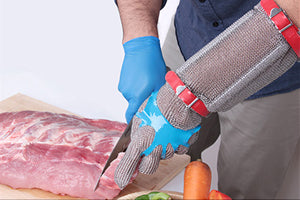
Put bluntly, layout should reduce effort. Workers in TPU or PVC aprons, sleeve protectors and non-slip footwear don't move the same way as staff in a front-of-house prep area. Their clothing is bulkier. Their surfaces are wetter. Their tasks involve heavier product and more repetitive handling. Equipment needs clear approach space, easy clean-down access and enough side clearance for safe loading and unloading.

A packing area is a good example. When portioning, sealing and bag staging happen in one tight cluster, staff can keep product under control and maintain rhythm. If you want a practical view of how sealing systems fit into faster output and cleaner handling, this guide on vacuum machines for efficiency and freshness is worth reviewing alongside your floor plan.
What works on a meat processing floor
The best-performing rooms usually make a few disciplined choices:
- Bandsaw near cold-side prep: Product comes out of storage and goes straight to breakdown, without warming on a waiting bench.
- Mincer next to trim and portion work: Staff can feed product directly instead of ferrying lugs across the room.
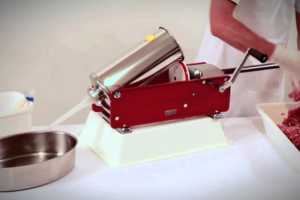
- Sausage filler close to mixing and casing setup: That cuts handling and keeps the line moving.
- Vacuum machine beside final portioning: Trays or cuts move one direction and don't double back.
- Knife storage and tool carry near the station: Workers aren't walking off the job to find what they need.
A butcher room often runs better when the equipment cluster follows the order of handling rather than the order of purchase. Owners sometimes buy the right machines and still lose efficiency because the machines are positioned by wall space, not by task sequence.
Put the next machine where the product goes next, not where the power point happens to be.
A simple equipment decision filter
Before signing off on any equipment placement, test each station against these questions:
- Can the operator load and unload without stepping into a traffic lane?
- Can another worker pass behind them safely while they're using the machine?
- Can the station be hosed, wiped or sanitised properly without moving half the room?
- Does the product move forward to the next task, or back across the floor?
- Can the worker use the machine comfortably while wearing site PPE?
That last point doesn't get enough attention in generic guides. In wet and wash-down environments, aprons, gloves, sleeves and boots change how people stand, turn and reach. A station that feels acceptable in an empty room can become awkward once a worker is suited up and the floor is active.
The rooms that perform best don't just fit equipment. They fit the human movement around that equipment.
Essential Services Ventilation and Utilities
The services package decides whether the room stays usable once production starts. Ventilation, drainage, water, power and waste handling aren't support items. They're part of the operating system. If they're underdone, staff compensate with workarounds, and those workarounds usually create heat stress, hygiene risk or downtime.
Ventilation has to match the room
Ventilation needs to suit the actual mix of cooking, steam, moisture, wash-down and odour in the room. In a hot kitchen, extraction has to deal with heat and grease. In a butchery or processing area, the issue is often moisture, odour control and maintaining a room people can work in for long shifts without condensation building up on surfaces.
Poor ventilation causes obvious trouble. Staff tire faster. Surfaces stay damp longer. Cleaning takes longer because the room never dries properly. Grease and residue build where airflow is poor. In mixed-use sites, smells can drift into clean zones or customer-facing areas.
The practical trade-off is simple. Oversimplified ventilation design looks cheaper during fit-out and costs more in operation. Once the room is built, retrofitting extraction paths, make-up air, duct changes or canopy changes becomes disruptive and expensive.
Utilities need to support wash-down and heavy equipment
Power should sit where the work happens, not where someone can make it reach. Extension leads and temporary cable paths don't belong in production spaces, especially wet ones. Fixed equipment such as mincers, slicers, sealers and saws need power planned around the workflow so operators can work without cords crossing walkways.
Water is the same story. You need enough supply where prep, sanitation and wash-down take place. If workers have to drag hoses through active paths or wash tools in the wrong sink because access is easier, the room is telling you the design is wrong.
A service review should include these checks:
- Drain placement: Wet areas need drains where water naturally runs during wash-down, not where they looked tidy on the drawing.
- Floor falls: Water has to leave the work area without pooling near benches or machine legs.
- Hose reach: Cleaning teams should be able to wash the room without pulling lines through product areas.
- Outlet location: Power access should support fixed workstations and prevent trip hazards.
- Isolation access: Staff and maintenance teams need to reach shut-offs without moving equipment.
In meat rooms and abattoir support spaces, service planning also affects cleaning time. If drains are badly located, staff push water around instead of removing it. If outlets are too low, too exposed, or too far from the machine, the station becomes awkward and harder to maintain.
That's the pattern across every failed utility plan. The room still functions, but only because people work around the design. That's expensive labour disguised as a building decision.
Hygienic Finishes and Effective Cleaning Regimes
A room can have a smart layout and still be difficult to keep clean. That usually comes back to surfaces. Hygienic finishes aren't about appearance. They decide how long wash-down takes, whether residues collect in hidden edges, and how consistently the team can return the room to a safe state.
Good finishes save labour every day
In wet food areas, the best materials are the ones that don't absorb, don't trap residue and don't break down under frequent cleaning. Australian kitchen planning guidance requires food-contact surfaces to be 304-grade stainless steel with continuously welded and ground joints, and it also requires dedicated handwashing basins within 5 metres of any food handler, without crossing prep or cleaning zones, using a non-manual faucet system, according to this Australian commercial kitchen planning guide.
That standard points to the bigger issue. Every seam, lip, void and rough transition turns into a cleaning problem. In butcher and processing environments, that problem gets worse because proteins, fats and fluids find every weak point.
The easiest room to sanitise is the room that gives contamination nowhere to hide.
Floor and wall junctions matter more than most operators expect. Floors should slope toward drains and be coved 100mm up walls in Australian commercial kitchen planning, as noted in this design-phase kitchen reference. That detail removes hard corners where residue and moisture collect, especially in wash-down areas.
Handwashing and hygiene access can't be an afterthought
Handwashing stations fail when they're technically present but awkward to use. If staff have to walk around a bench, pass through another zone, or dodge a trolley to wash hands, compliance slips in practice.
The basin needs to sit where the task changes happen. Near entry into prep. Near transitions from raw handling to another activity. Close enough that workers can use it without leaving the flow of the job. Pedal or photocell operation matters for the same reason. The less contact required, the cleaner the sequence.
For teams working in heavy PPE, access matters even more. Wet aprons, gloves and sleeves change movement. A basin squeezed into a narrow gap may satisfy a drawing but still fail the floor test.
Compare smart finishes against problem finishes
This comparison is where many fit-outs either save time for years or create a daily nuisance.

| Better choice | Why it works | Problem choice | What goes wrong |
|---|---|---|---|
| Stainless steel benches | Non-porous, durable, easier to sanitise | Damaged laminate | Swells, lifts and traps moisture |
| Seamless or well-finished flooring | Washes down faster and holds up to chemicals | Rough concrete | Holds grime and is hard to clean properly |
| Coved wall-floor junctions | Removes corners where residue builds | Sharp wall-floor junctions | Dirt and wash residue collect in the edge |
| Washable wall linings | Stand up to repeated cleaning | Absorbent or damaged wall surfaces | Hold moisture and mark easily |
The wrong finish doesn't usually fail on day one. It fails in the routine. Cleaning takes longer. Edges start to break down. Staff skip hard-to-reach spots because they're frustrating to clean. Then the room carries a hygiene burden every shift.
Good commercial kitchen design makes cleaning simpler, faster and more consistent. That's not cosmetic. It's operational.
Navigating Compliance Safety and Budgeting
Compliance, safety and cost usually get discussed as separate issues. On a working site, they're tied together. The cheapest shortcut in the fit-out stage often becomes the most expensive safety or compliance problem later.
Compliance starts with usable space
One of the clearest Australian benchmarks is the space allowance. Commercial kitchens must allocate a minimum of 0.5 square metres of kitchen space per seat, or 20 square metres per 50 seats, including washing stations, according to this Australian design guidance on AS 4674-2004 kitchen planning. That requirement isn't just about floor area. It protects workflow separation between raw prep, vegetable processing and clean dish return paths.
In practical terms, usable space is compliance. If staff can't separate tasks properly because the room is too tight, the site is fighting the standard from the start.
A small hospitality venue sees this in dish return and prep overlap. A butcher or processor sees it when raw handling, packing and clean tool return all compete for the same footprint. Different business. Same problem. Not enough room for clean separation.
Safety comes from layout plus PPE
A compliant room still needs safe behaviour, and safe behaviour is easier when the layout supports it. Workers in wet and high-contamination environments need space to move while wearing aprons, sleeve protectors, gloves, eye protection and non-slip footwear. If the station layout ignores that bulk and restricted movement, the PPE becomes harder to work in and people start taking shortcuts.
That's why layout and PPE should be planned together. The machine clearance has to account for the operator's actual working posture. Tool storage needs to support safe carry. Entry and wash points have to suit the shift pattern. Wet zones need clear boundaries so staff know when waterproof gear and wash-down procedures change.
If your site is formalising those standards, this overview of food safety excellence through HACCP in Australia is a useful companion to the design discussion.
A safe room doesn't rely on careful people doing heroic things all day. It makes the safe action the easy action.
Budget for sequence, not just spend
Budgets get blown when owners price equipment before they lock the workflow, services and hygiene surfaces. That's backwards. The spend should follow the operating sequence.
A practical budgeting order looks like this:
- Fix the workflow first: Receiving, storage, prep, production, packing or service, wash, waste.
- Lock in the hard services: Ventilation, drainage, water, power and access.
- Choose the surfaces: Benches, floors, wall finishes, junctions, wash points.
- Place the core equipment: Put the high-use machines where product travels.
- Stage optional additions later: Secondary benches, storage enhancements, non-critical upgrades.
That sequencing protects capital because it prevents rework. Owners can phase some purchases. They can't cheaply move drains, rebuild a wash zone, or re-route a cramped production lane after the room is live.
Budget discipline in commercial kitchen design isn't about buying less. It's about buying in the right order, so safety, compliance and output don't get compromised by false savings.
Conclusion From Plan to Profit
A high-performing kitchen isn't built around guesswork. It's built around flow, zoning, ergonomic equipment placement, strong services, hygienic finishes, and a layout that respects the people doing the work. That matters in every venue, but it matters most in wet, high-contamination environments where staff handle heavy product and rely on PPE all shift.
Good commercial kitchen design protects output because it protects the team. If you're planning a new fit-out or fixing an underperforming room, start with the path people and product take. Then build around that.
If you're specifying equipment, PPE, packaging, or processing supplies for a butcher shop, abattoir, hospitality venue or food production site, PSC TRADING Co PTY LTD supplies machinery, protective workwear and food-processing essentials built for demanding Australian environments.
