

You're probably in one of two spots right now. Either you've been asked to order branded aprons for a team and discovered that most search results are aimed at home cooks, cafés, and gift buyers, or you've already bought a batch that looked fine online and failed the moment they hit a real shift.
That usually shows up fast. A butcher ties on a light cotton bib, starts trimming, mincing, sealing and cleaning down, and by mid-shift the fabric is wet through, the straps are twisting, and the logo already looks like it won't survive repeated washing. In a commercial kitchen, the problem is different but just as obvious. Front-of-house aprons can look sharp, while prep and wash areas need something built for splash, grease, sanitisers, and constant movement.
That's the main issue with personalized aprons Australia buyers run into. The market is full of decorative options. Professional buyers need workwear that can still carry a brand, but only after it meets the job first.
Table of Contents
- Beyond the Cafe Why Professionals Need a Different Kind of Apron
- Choosing Your Armour Professional Apron Materials
- Custom Branding for the Toughest Workplaces
- Sizing Fastenings and Work-Ready Accessories
- Food Safety Washdown Suitability and Compliance
- Why Sourcing from an Australian Manufacturer Matters
- Your Step-by-Step Guide to Ordering Bulk Aprons
Beyond the Cafe Why Professionals Need a Different Kind of Apron
A lot of buyers start with the wrong comparison. They search for personalised aprons, see linen bibs, soft cotton café styles, and novelty prints, then assume they can add a logo and call it done. That works for light service. It doesn't work in a butcher shop, abattoir, or a commercial kitchen with a serious wash area.
One of the most common scenarios is a new shop fit-out. The owner wants the team to look consistent, so they order aprons that suit the brand colours and add names or a logo. On the first busy day, the aprons absorb moisture, hold odours, and start feeling heavy. The branding wasn't the mistake. The base apron was.
In professional environments, an apron is part uniform, part barrier, and part workflow tool. It has to protect clothing, reduce exposure to splash and residue, move cleanly with the body, and clean down without fuss. In wet processing, it also needs to resist fluids and repeated cleaning cycles. That's a completely different brief from a café apron worn mostly for presentation.
Practical rule: If the apron would suit a gift shop, it probably isn't the right starting point for a meat room or wash-down area.
There's also a content gap in the Australian market. A lot of “personalised” apron pages focus on visual customisation, but they don't answer the questions trade buyers ask. Which materials suit wet zones? What fastening system is easier with gloved hands? Will the apron hold up around bandsaws, mincers, vacuum packing benches, and frequent sanitation?
That gap matters because the working conditions are not theoretical. In Australian food processing, 92% of food processors cite fluid exposure as a primary occupational hazard, while many local personalised apron options are still focused on non-certified linen or cotton styles that don't meet wet-zone expectations, as noted on Cargocrew's personalised apron range.
A buyer who understands that difference usually changes approach quickly. Instead of asking, “Which apron looks best with our logo?”, they ask, “Which apron survives our environment, then carries our logo properly?” That's the right sequence.
If you're sorting options for a tougher workplace, this practical note on aprons built for hard daily use is closer to the actual decision than most retail-style apron pages.
Choosing Your Armour Professional Apron Materials
Material decides almost everything. It affects how the apron handles fluids, how stiff or flexible it feels through a shift, how easy it is to clean, and whether branding will last. If you choose the wrong material, no amount of embroidery or printing fixes it.
The first filter is simple. Separate wet processing and wash-down use from light hospitality and dry work. Once you do that, the shortlist gets much clearer.
What works in wet zones and what doesn't

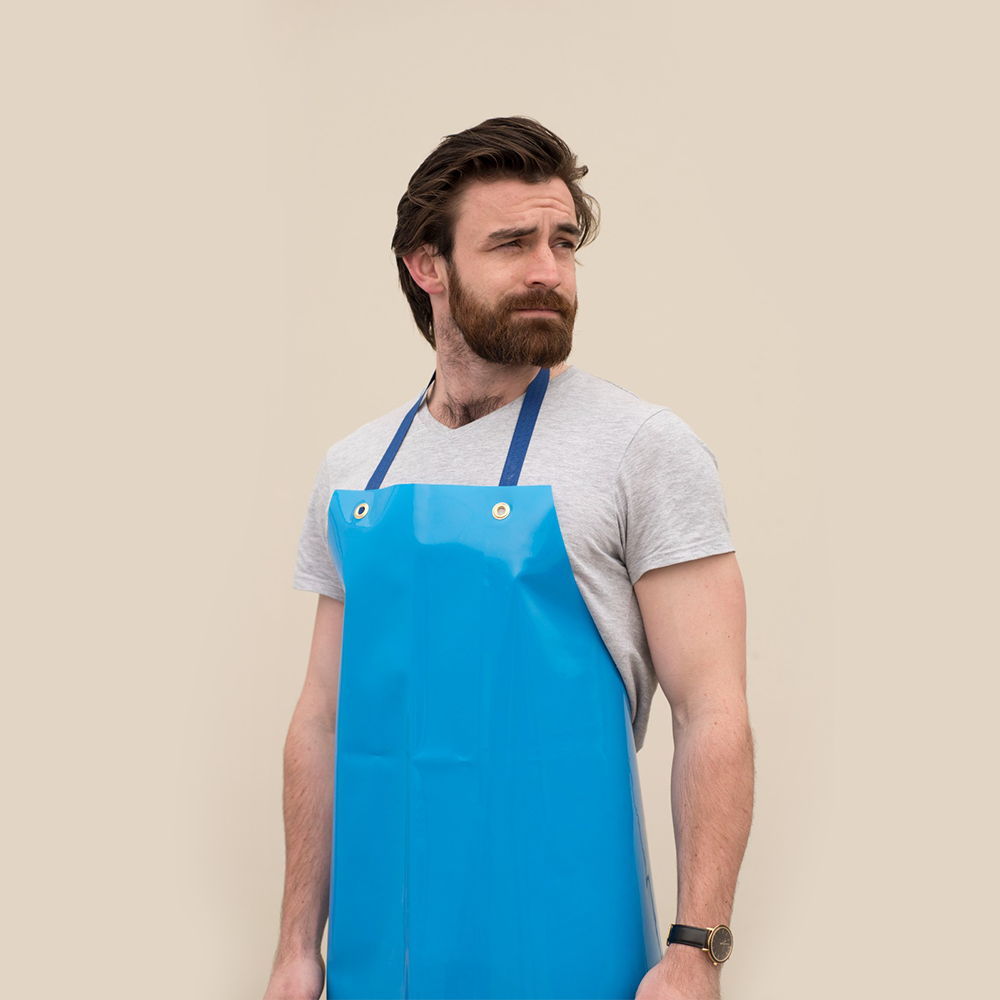
For wet areas, TPU and PVC are the serious options. They're built around fluid resistance and easier wash-down. That's why buyers in butchering, seafood handling, and abattoir work keep coming back to those categories. They don't soak up the day's work the way absorbent fabrics do.
For front-of-house, service, or workshop roles, waxed canvas, poly-cotton, denim, or leather can make sense. They offer a different balance. Better presentation, more texture, and often more comfort in dry conditions. The trade-off is obvious. They aren't the apron you want in a wet processing line where splash and sanitation are constant.
The compliance side matters too. Australian-made personalized aprons used in food-processing environments must comply with OEKO-certified synthetic fabrics to meet AS 4801 workplace safety standards. High-performance fabrics provide a critical barrier against soak-through from meat juices and sanitizers, a mandatory requirement under Australia's Food Standards Code for businesses handling raw meat, according to this apron materials reference.
If you're comparing synthetic food-processing materials directly, this guide on TPU versus PVC food-processing aprons is a useful starting point.
In practice, the right question isn't “Which material is nicest?” It's “Which material fits this room, this task, and this cleaning routine?”
Apron Material Comparison for Professional Use
| Material | Best For | Water Resistance | Durability | Cleaning |
|---|---|---|---|---|
| TPU | Wet food-processing areas, meat rooms, wash-down zones | High | High | Easy to rinse and clean |
| PVC | Waterproof industrial use, dishwashing, wet prep | High | High | Easy to wipe and wash |
| Waxed canvas | Front-of-house, dry prep, workshop-style use | Moderate | High | Needs more careful cleaning |
| Poly-cotton | Hospitality service, café floor, light kitchen use | Low to moderate | Medium | Easy general laundering |
| Leather | Workshops, heat-adjacent tasks, rugged dry environments | Low | High | Requires maintenance, not ideal for wet food zones |
A few practical judgments help:
- Choose TPU when the team needs waterproof protection without a heavy, stiff feel.
- Choose PVC when you want a straightforward waterproof workhorse for messy, repetitive tasks.
- Choose waxed canvas for a premium look in dry service or open-kitchen settings.
- Avoid absorbent fabrics in rooms where splash, blood, grease, or sanitiser contact is routine.
Most mistakes happen when buyers try to make one apron cover every role. That sounds efficient, but it usually means someone ends up under-protected or over-dressed for the job.
Custom Branding for the Toughest Workplaces
Branding on workwear only works when the branding method matches the apron material. That's where a lot of custom orders go wrong. Buyers pick a logo treatment first, then try to force it onto a material that won't hold it well.
In hard-use environments, the logo has to survive cleaning, handling, flexing, and regular abrasion. A fine-detailed decorative print that looks sharp on a sample can fail quickly on the wrong base.

Match the branding method to the apron
Screen printing suits bold, simple logos on smoother industrial materials. If a butcher shop wants a one-colour mark that can be seen clearly across the bench, this is often the cleanest choice. It's especially practical when the artwork is simple and the apron itself is meant for repeat heavy use.
Heat transfer suits more complex artwork, finer detail, or more colour variation, particularly on textile-style aprons used in hospitality. It can produce a cleaner visual result for cafés or restaurants where visual presentation matters more than heavy wet-zone protection.
Embroidery works best on canvas, nylon, or hospitality aprons where texture adds to the look. For premium front-of-house uniforms, embroidery can lift the appearance of the garment. On waterproof industrial aprons, it's often the wrong move because puncturing the material or adding stitched bulk can work against the apron's purpose.
A practical example makes this easier:
- A butcher logo with block lettering usually suits screen printing.
- A café logo with fine line detail or a multicolour crest often suits heat transfer or embroidery on a dry-use apron.
- A kitchen team name on a service apron may be ideal for embroidery if the garment won't be exposed to constant soaking and wash-down.
What holds up on shift
The test isn't how the logo looks on day one. The test is how it looks after repeated wear and cleaning. That's why branding decisions should be based on the actual work area.
Use this quick filter before approving artwork:
- Check the environment first. Wet room, prep line, front counter, open kitchen, dish area.
- Choose the apron second. Material and cut come before decoration.
- Simplify the logo if needed. A clean one-colour mark often outperforms a complicated graphic.
- Ask how the branding is applied. Don't assume every method works on every apron.
- Request a visual proof. Placement matters. Chest print that sits too high or too low usually looks awkward in use.
For buyers who need branded options rather than plain protective gear, printed work apron customisation options give a good sense of how branding can be applied to practical workwear.
A logo should make the team look organised. It shouldn't become the weak point of the apron.
Sizing Fastenings and Work-Ready Accessories
An apron can be made from the right material and still be wrong for the job if the fit and fastening are poor. That shows up in small ways first. The hem catches where it shouldn't, the straps loosen during the shift, or the wearer keeps adjusting the bib instead of working.
In busy food environments, those small irritations become safety issues and time losses.
Fit before style
For general adult use, 86 cm by 72 cm is the common benchmark for personalised aprons in Australian hospitality and food-processing settings because it balances coverage and movement, according to this Australian apron size listing. That size suits the one-size-fits-all reality many workplaces need. It covers the torso and upper thighs without throwing excess fabric around the legs.
That matters more in a butcher room than many buyers realise. Too much apron can interfere near equipment and benches. Too little apron leaves clothing exposed to splash, fats, blood, and general residue from the shift.
There's also a more practical fit rule used on site. In hospitality and butcher environments, the bib should reach the chest and the hem should fall below the knees for proper fluid protection, with PSC Trading Australia's apron buying guide noting a standard poly-cotton bib apron in 235 gsm with adjustable straps as one working example.
Fastening systems that help instead of hinder
The fastening system affects speed, comfort, and snag risk. That's not a minor detail.
Some teams still prefer traditional ties because they're familiar and simple. They work well enough in light use, but they can be slower with gloved hands and may loosen or twist through the day.
Other systems are built for faster handling:
- Hook systems sit flatter and can reduce snag points around the workstation.
- Buckle ties are easier to repeat consistently across a team.
- Cord-and-hook sets can speed up on-off use where aprons are cleaned or changed regularly.
One option in the market is PSC Trading, which offers accessories including classic and flat apron hooks, flat strap and buckle ties, and cord-and-hook sets that help secure tools and improve workflow at the bench, as shown in its customized apron accessories range.
That matters in real work. A butcher trimming at one bench, moving to mincing, then stepping over to vacuum packing doesn't want loose ties, twisted straps, or tools hanging awkwardly. A flat hook setup can sit cleaner against the body and stay out of the way.
A good apron system can also include add-ons such as knife pouches or butcher belts. The point isn't to load the apron with extras. The point is to keep necessary tools secure, accessible, and consistent from shift to shift.
Food Safety Washdown Suitability and Compliance
If the apron is going into a food-processing environment, the buying standard changes. At that point, you're not shopping for branded apparel. You're selecting protective equipment that also carries a brand.
That distinction matters because many custom apron listings never tell you what you need to know. They show colours, print areas, and style choices, but leave out material safety information, wash-down suitability, and whether the apron fits wet-zone use at all.
What food-grade really means in practice
In practical terms, food-grade apron materials need to be suitable for contact-heavy environments where splash, residue, and cleaning are part of the day. Buyers generally want a surface that is non-absorbent, easy to clean, and resistant to soak-through. Cotton and linen have their place in hospitality, but in wet raw-product handling they can hold moisture and become the wrong tool.
That's why industrial buyers keep coming back to waterproof synthetics for wash-down work. A good wet-zone apron should rinse clean, handle repeated sanitation, and keep doing the basic job of protecting the wearer underneath.
There's also a clear market gap around this requirement. A common unanswered buyer question in Australia is which personalised aprons meet AS/NZS 2207 expectations for abattoir and meat-processing use while still allowing branding, with many AU-focused custom apron sites concentrating on appearance rather than safety data. That gap is reflected in The Tshirt Mill's apron customisation page, which highlights aesthetic customisation while leaving industrial material disclosure unclear.
If a supplier can talk about print colours but can't explain wet-zone suitability, you're probably looking at the wrong product category.
What to ask a supplier before you buy
Use a short compliance checklist before approving any order:
- Ask for the material specification. You need to know whether the apron is suited to food-processing conditions.
- Ask about wash-down use. Some aprons survive normal laundering but aren't built for repeated industrial cleaning.
- Ask whether the surface is absorbent or non-absorbent. That single point rules many consumer-grade aprons in or out.
- Ask how branding affects the garment. A good apron can become a poor one if the decoration method compromises the surface.
- Ask where it will be worn. Prep bench, service floor, dish area, meat room, abattoir floor. The room decides the spec.
Compliance starts with the material, but procurement failures usually happen at the briefing stage. Someone orders for “the team” without splitting the roles by environment. That's how a dry-use branded apron ends up in a wet room where it was never meant to be.
Why Sourcing from an Australian Manufacturer Matters
Local supply matters most when the order is specific. Plain imported aprons can be easy enough to source. The moment you need custom branding, a wet-zone material, a particular fastening setup, or a tweak to suit the way your staff work, local manufacturing becomes much more practical.
That's even more true when the buyer is balancing multiple rooms. A hospitality group might need one apron type for service and another for prep. A butcher might want waterproof aprons for the processing side and branded bib aprons for the retail counter. Those are easier conversations when the supplier understands the local trade context.

Local supply solves practical problems
The biggest advantage is communication. If the apron needs a logo moved, a strap changed, or the wrong material has been quoted for the intended room, you can sort that directly. That matters because custom work often needs a few rounds of clarification before it's right.
There's also the standards question. When you're buying for Australian butchering, hospitality, and food-processing environments, it helps to deal with a supplier working inside those expectations rather than one guessing at them from offshore.
A concrete example is that PSC Trading PTY LTD, founded in November 2013 and based in Rosebud, VIC, manufactures Australian-made aprons in waterproof TPU and PVC materials specifically for wet and wash-down zones in meat processing and abattoirs, as stated on the company's Australian manufacturing site information.
Why this matters more for custom workwear
For everyday stock items, lead time is only one part of the equation. For personalised aprons, approval time often matters more. Artwork has to be checked, placement confirmed, and material choice validated against the workplace.
A local manufacturer is also easier to brief properly. You can describe the actual task, not just the product. For example:
- Retail butcher floor: presentable branded bib apron, lighter duty acceptable.
- Boning room or wet prep: waterproof synthetic apron, easier clean-down, simple branding.
- Commercial kitchen front-of-house: polished textile look, comfort and presentation.
- Dish or wash area: barrier performance first, branding second.
That kind of role-based ordering usually produces better results than trying to buy one universal apron for the whole site.
Local manufacturing won't automatically fix a poor brief. It does make it easier to correct one before production starts.
Your Step-by-Step Guide to Ordering Bulk Aprons
Once you know the difference between decorative aprons and work-ready ones, ordering gets simpler. The main thing is to brief the supplier with the job in mind, not just the brand.
A rushed order usually starts with colour and logo. A good order starts with environment, task, and cleaning routine.

A practical ordering checklist
-
Define the actual use
Don't write “team aprons” and leave it there. Split the order by role. Counter staff, prep staff, dish area, meat processing, service floor. One venue can easily need more than one apron type.
-
Choose the material for the room
Wet zones need waterproof, easy-clean materials. Dry service areas can prioritise appearance and comfort. If you mix those up, the apron either fails too quickly or feels wrong all shift.
-
Decide how the branding will be applied
Match the logo method to the base apron. Bold, simple marks tend to perform better on hard-use garments. Detailed decorative branding suits lighter-use hospitality aprons.
-
Confirm fit and fastening
Don't treat this as an afterthought. The apron has to cover properly, move cleanly, and fasten in a way your staff can manage without fuss.
-
List accessories separately
If some staff need hooks, knife pouches, or butcher belts, specify that clearly. Don't assume every apron in the order should carry the same extras.
-
Approve the proof before production
Check logo size, placement, apron colour, and fastening notes. Most avoidable mistakes are visible at proof stage.
What a clear brief looks like
A solid bulk enquiry is short and specific. For example:
- Business type: suburban butcher with retail front and back-room processing
- Apron split: branded bib aprons for retail staff, waterproof aprons for wet processing
- Branding: one-colour chest logo
- Fastening: flat hook preferred in the processing area
- Accessories: knife pouch required for selected staff only
- Quantity: listed by apron type, not as one combined total
That kind of brief gives the supplier something workable. It also helps you compare quotes properly, because you're comparing like with like.
The businesses that get the best result from Personalized Aprons Australia suppliers usually keep the buying logic simple. Protect the worker first. Fit the environment second. Brand the apron third. If that order gets reversed, the apron may look good in the box and disappoint on the floor.
If you're ordering for a butcher shop, abattoir, commercial kitchen, or mixed hospitality operation, treat the apron like equipment with branding, not branding with straps. That's the difference between an order that lasts and one that has to be replaced far too soon.
