





You know the morning already. The truck's late, the boning room's cold, the bandsaw needs to be up before the first carcass comes in, and someone's asking whether the mincer can handle trim without turning it warm and greasy. By the time the vacuum machine starts sealing portioned cuts, the question isn't “what machine should we buy?”, it's “what combination of gear, layout, and wash-down discipline will keep this room moving without becoming a cleaning problem?”
Table of Contents
- A Standard Tuesday in a Butcher Room
- The Four Core Equipment Categories and What Each One Does
- Sizing Equipment to Your Real Throughput
- Hygienic Design Rules That Decide Daily Survival
- How Equipment Connects to Workflow, PPE, and Cold Chain
- Choosing a Supplier That Stays After the Sale
- Why Bigger and More Automated Is Not Always Better
- A Practical Buying Checklist You Can Use Tomorrow
A Standard Tuesday in a Butcher Room
The first job on a busy morning is usually the one everyone notices. A bandsaw comes up to speed, a tray of trim shifts to the mincer, and the sausage filler gets staged where the operator can work without crossing back through the wet area. A vacuum machine waits at the edge of the bench, because once cuts are portioned, the clock changes from processing time to shelf-life time.
That sequence is why the equipment conversation has to start with the room, not the catalogue. In a small butcher shop or regional abattoir, the essential machines are those that let product move cleanly from breakdown to mince, from mince to fill, and from packed cuts to cold storage without awkward lifting or rework. The core categories are already well established in the sector, and their history shows why they remain standard across the Australian meat value chain, with mechanical mixers, stuffers, and choppers emerging in the 1880s, band saws and meat grinders in the 1920s, steam-powered equipment in 1880, the bowl chopper in 1895, and chilling equipment between 1894 and 1900. Technological evolution in meat processing
Practical rule: if the day starts with a pile of trim and ends with a queue at the packing bench, the right equipment problem is workflow continuity, not just cutting power.
What the floor is really asking for
A butcher room asks four questions every day. Which machines are essential, how much output the room needs, what will survive the wash-down, and how PPE fits around the motion of the work. Those questions decide whether a machine gets used smoothly or becomes another obstacle to step around.
The rest of this guide follows that same order. The next section names the four core machine categories, then capacity, then hygiene, then the way layout, PPE, packaging, and supplier support all lock together. If the reader is standing in front of a quoting folder right now, that's the right place to begin.
The Four Core Equipment Categories and What Each One Does

The four categories that carry most Australian meat rooms are bandsaws, mincers, sausage fillers, and vacuum machines. Everything else usually supports one of those jobs. A bandsaw breaks carcasses, primals, and frozen blocks into manageable pieces, a mincer turns trim into ground product, a filler portion-controls sausage mix into casings, and a vacuum machine closes the loop by extending shelf life through sealing.
A good bandsaw choice is less about the glamour of the blade and more about the way the machine sits in the room. Tabletop units suit compact butcher benches where cuts are lighter and operators can feed product by hand with short reach, while floor models make sense when you need a stable platform, more clearance, or easier movement around larger pieces. A mincer should be judged by how its screw auger, knife, and plate work together, because the plate hole size is what shapes the grind, not the marketing copy on the front panel. The NIFTEM training handbook describes mincing with a rotating spiral shaft or pump forcing boneless meat against a rotating knife and through a static end plate with holes sized from 1.5 to 13 mm. Meat handbook
Matching filler and vacuum choices to the product
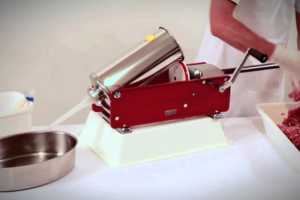
Sausage fillers are where many buyers under-specify. A piston stuffer may suit small batches and careful hand control, while continuous or vacuum stuffing becomes more relevant when the room wants steady output and tighter portioning. The casing matters here too, because natural casings behave differently from synthetic ones, and the filler has to suit that handling pattern.
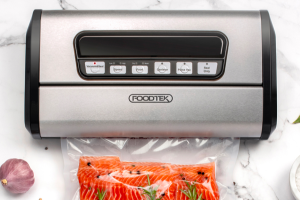
Vacuum machines also need to be picked for the product, not just the room size. Chamber machines suit a lot of butcher and small plant work because they handle bags and product placement in a controlled enclosure, while external and belt-style systems are chosen when packaging volume, product shape, or line integration shifts the requirement. Every one of those choices depends on compatible consumables, especially vacuum bags and casings, because the machine alone doesn't make a sellable pack.
For consumables and butcher-room fittings, the practical buying instinct is to look for a supplier that can keep the system together rather than selling the machines in isolation. One example is the combined catalogue at PSC Trading's butcher supplies range, where equipment and support items are presented as one working set rather than separate purchases.
Sizing Equipment to Your Real Throughput
The fastest way to waste money is to buy for a future room that doesn't exist yet. The second fastest is to under-buy and then ask the machine to run outside its comfortable duty cycle. Commercial meat processing equipment commonly sits on 400 V / 50 Hz three-phase supply, with small tabletop grinders around 1.1 kW, block cutters around 4 kW, and higher-capacity grinders reaching 7.5 to 45 kW depending on target output. Throughput and power envelope
A small grinder may deliver about 450 to 600 kg/h, a 4 kW cutting machine is listed at 1,500 kg/h, and larger industrial lines can reach 2,000 to 25,000 kg/h with 90 to 200 kW motors. The point isn't that bigger is better. It's that capacity scales with power density, feed consistency, and how well the machine handles temperature without smearing fat or slowing discharge.
A simple capacity frame
| Operation size | Typical motor range | Indicative throughput | Supply |
|---|---|---|---|
| Home butcher or small retail | About 1.1 kW | About 450 to 600 kg/h | 400 V / 50 Hz three-phase |
| Single shop | Around 4 kW | About 1,500 kg/h | 400 V / 50 Hz three-phase |
| Multi-shop | About 7.5 to 45 kW | Varies with line design | 400 V / 50 Hz three-phase |
| Small plant | 90 to 200 kW | About 2,000 to 25,000 kg/h | 400 V / 50 Hz three-phase |
Supplier question to ask: “What hourly output did you size this for, and what happens when the product is colder, softer, or fed in unevenly?”
That question matters because the machine's real duty cycle is what drives the result, not the headline motor number. If the trim arrives warmer than expected, or if the operator is feeding mixed product rather than uniform blocks, the system needs torque reserve and overload protection more than it needs a bigger blade. Under-sizing leads to drag, heat buildup, and poor texture, while over-sizing without a cleanable build just creates another expensive surface to wash.
Hygienic Design Rules That Decide Daily Survival
Most machines look fine under showroom lights. They start to separate on day two, when hot-water cleaning, detergent, residue, and time pressure all hit at once. For Australian meat rooms, the test is whether the equipment is built for humid wash-down work, with 304 or 316 stainless on product-contact surfaces, fully enclosed motors, and sealed electrics that won't be punished by direct cleaning. Hygienic design guidance
The same guidance calls for product-contact surfaces that are smooth, free of pits and crevices, self-draining where possible, with internal corners in the product zone having a continuous radius of at least one-fourth inch, 16.35 mm, where possible, and welds that are smooth and flush to adjacent surfaces. Those details matter because residue trapped in a seam turns into extra scrub time, microbial risk, and eventually corrosion. A machine that traps water is harder to sanitize and more likely to fail early.
What to check before you sign
- Touch the welds: Smooth, flush welds are easier to clean and less likely to harbour residue.
- Inspect the corners: Tight internal angles are where grime collects first.
- Check the motor housing: If it isn't properly sealed, daily wash-down becomes a liability.
- Look underneath: Drainable geometry matters as much as polished top surfaces.
A showroom test tells you a lot. Tip the machine if you can, look under the seal, run a finger along the welds, and check whether the electrics are enclosed rather than exposed. If the build looks hard to clean in a dry showroom, it will be worse after a full shift in a wet room. For buyers who want a practical cross-contamination reminder alongside the gear itself, this PSC Trading hygiene resource is worth keeping in the quote folder.
How Equipment Connects to Workflow, PPE, and Cold Chain
A machine that fits on paper can still fail in the room if the carcass rail, bench, and packaging station don't line up with how people move. The planning logic from small-plant design guidance is simple, layout should follow product flow, activity relationships, and supervision needs, while carcass rail height has to suit carcass size and working height rather than a one-size-fits-all assumption. Small red meat plant design
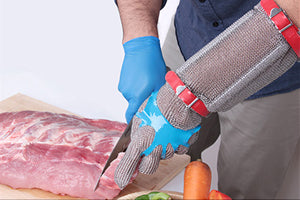
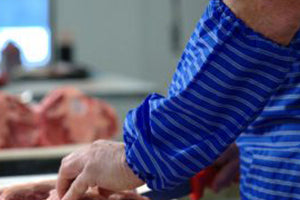
That is why PPE belongs in the equipment conversation. Waterproof TPU or PVC aprons, hand protection, eye and hearing protection, and sleeve protectors are part of the machine system because the operator's reach, splash zone, and cleaning cycle all change when the room adds a bandsaw or vacuum packer. PSC TRADING Co PTY LTD is one example of a supplier that combines machinery with aprons, PPE, packaging, and consumables in one catalogue, which matters when the same floor needs a stuffer, vacuum bags, and washable workwear.
A small shop adding vacuum sealing
Take a butcher shop that adds a chamber vacuum machine. The packaging bench suddenly needs more surface room, vacuum bags have to be stocked in the right sizes, and product has to arrive at the sealing point already portioned and dry enough to pack cleanly. That same change often pushes the operator toward a better apron choice, because pack-off work and bag handling happen after trimming, not before it.
Cold chain choices should be specified at the same time. Vacuum packaging only helps if the room has a disciplined route into chill or freezer storage, and pallet spacers can support airflow where freezing or staging depends on stacked product movement. If the buyer is already thinking about storage, cold-chain management guidance belongs in the same procurement folder as the machine quote.

Buying a machine is really buying a movement pattern, a cleaning routine, and a packaging hand-off.
Choosing a Supplier That Stays After the Sale
A good supplier doesn't just drop a crate at the dock. They help keep the room running when a blade dulls, a seal wears out, or the operator needs the right bag, casing, or apron without calling three different vendors. The strongest buyers look for a single catalogue that spans machinery, consumables, PPE, packaging, and wear parts, because on a butcher floor a missing plate or seal can stop production just as fast as a failed motor.
The first question is spare parts. Blades, plates, knives, seals, and other common wear items should be easy to identify, easy to reorder, and clearly linked to the machine model. The second is documentation, because an operator needs more than a price sheet, they need clean assembly guidance, maintenance intervals, and support when the same machine has to pass inspection as well as perform.
Supplier questions worth asking
- Warranty and service: What's covered, and who services the machine locally?
- Spares lead time: Are blades, plates, knives, and seals stocked or imported on request?
- Hygiene support: Can the supplier explain how the build suits wash-down and inspection?
- Consumables range: Can they also supply casings, vacuum bags, branding ink, and PPE?
- Procurement flexibility: Can the catalogue support multi-currency browsing if you're comparing options internationally?
The supplier also needs to understand the rest of the room. Aprons, sleeve protectors, vacuum bags, and packaging are not side products in meat processing, they're part of the same operating system. When a wholesaler can cover both equipment and the items that keep it moving, the buyer spends less time chasing separate accounts and more time keeping production steady.
Why Bigger and More Automated Is Not Always Better
The industry is moving toward automation, but the limits matter. Research on robotic and automated meat systems points to real gains, while also highlighting hygiene challenges, cut variability, and integration complexity that make full automation a poor fit for every small-to-mid-volume room. Robotic and automated systems in meat processing
That's the part too many catalogues skip. An independent butcher shop, regional abattoir, or hospitality kitchen often gets a better result from semi-automation than from a full-line replacement, because sanitation, changeovers, and product diversity eat into theoretical productivity. Skilled labour scarcity is still a live issue in meat and poultry plants, but that doesn't automatically mean the answer is the largest machine on the market.
A properly specified 4 kW grinder can be the better business choice for a single shop than a larger industrial unit. It uses less energy, cleans faster, and is more likely to be adopted by the actual operator on shift. Bigger equipment can look impressive and still underperform if the room is too small, the feed path is awkward, or the wash-down takes too long to justify the extra capacity.
The practical test is simple. If changeovers are frequent, product sizes vary, and the room is wet, the smartest purchase is often the machine that matches the actual rhythm of the floor rather than the one that sounds most advanced in a brochure. Automation should remove friction, not create a new maintenance burden.
A Practical Buying Checklist You Can Use Tomorrow
A purchase decision gets clearer when the questions are blunt. Start with the core set, because every quote should identify exactly which of the four categories it covers and what it leaves out. Then move to capacity, hygiene, workflow, and supplier support in that order.

Use these questions on the next site walk
- Core equipment set: Does this quote cover the jobs we do, bandsaw, mincer, filler, vacuum machine, or is it just one part of the chain?
- Capacity match: Is the motor rating and throughput aligned to our real hourly peak, not a theoretical future expansion?
- Hygienic design: Can the motor housing survive daily hot-water cleaning, and are the welds, corners, and surfaces easy to inspect?
- Workflow fit: Will the machine work with our rail height, bench layout, PPE stations, and packaging bench without forcing extra lifts or cross-traffic?
- Supplier support: Does the supplier stock spare blades, plates, knives, seals, bags, casings, and the other wear items we'll need?
Final check: if a machine is hard to clean, hard to feed, or hard to source parts for, it's not a good purchase even if the price looks sharp today.
Keep the quote folder simple. Add the capacity questions, ask for the wash-down details, and mark whether the supplier can support consumables and PPE as part of the same order. If you're comparing options for a butcher room, abattoir, or food plant, the next step is to walk the floor with this checklist, compare at least two quotes against it, and pick the machine set that fits the room you have, not the room you wish you had.
